CDN vs Origin Monitoring: Why You Need Separate Availability Checks
A healthy public domain check only proves your cache is working, it says nothing about whether your origin server is actually alive underneath it. Learn why separate CDN and origin checks cut diagnosis time from an hour to two minutes.
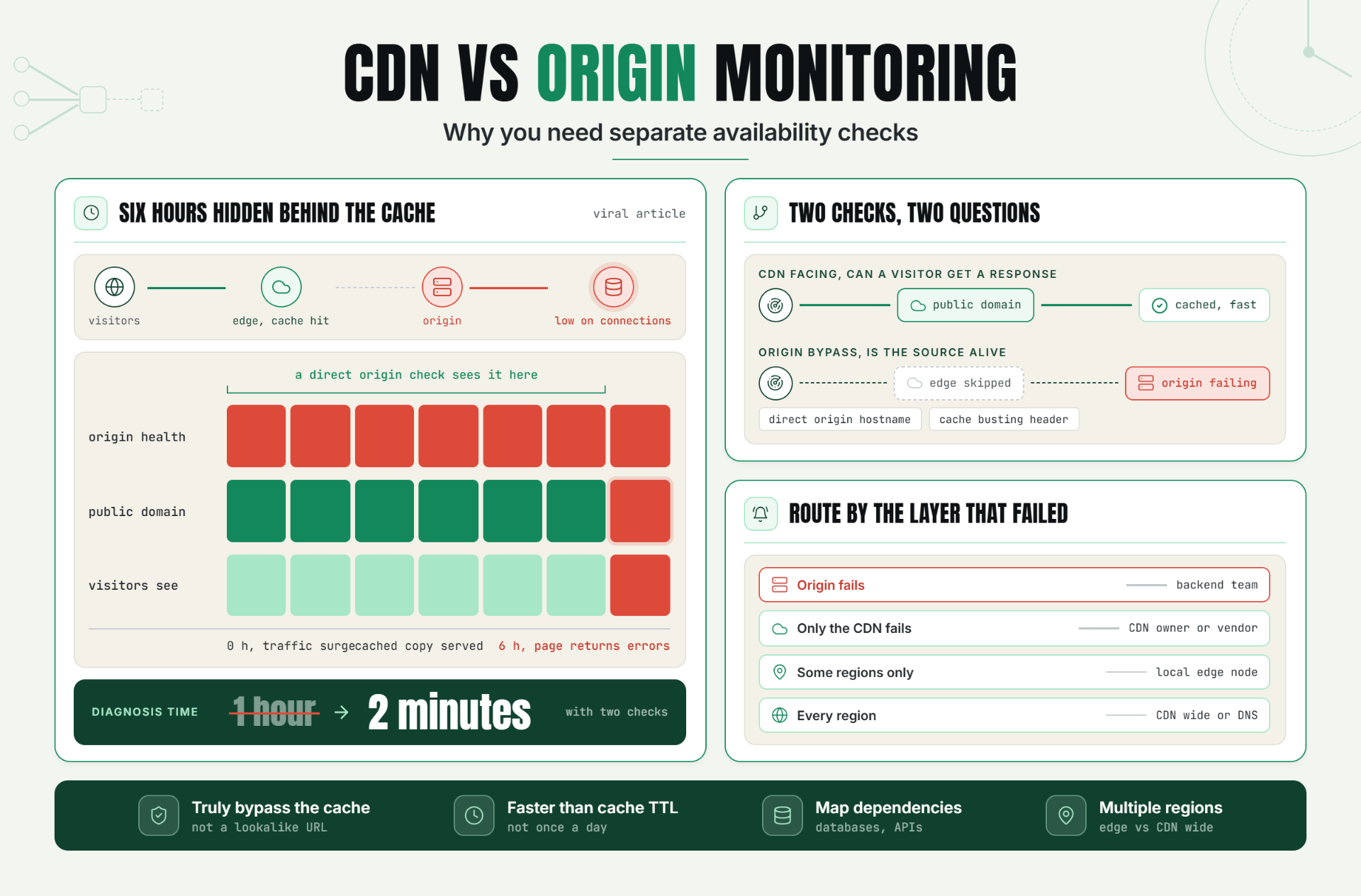
Your monitor checks your domain, gets a fast, healthy response, and moves on. What it doesn't tell you: whether that response came from a CDN edge cache, or from your actual origin server working through a live request. Those are two different systems, and a single check against your public domain can't tell you which one just answered.
This is the core reasoning behind CDN vs origin monitoring: if you only ever check the front door, you have no way of knowing whether the thing behind it is still standing. Separating these two checks isn't extra complexity for its own sake it's the difference between diagnosing a failure in two minutes and spending an hour ruling out systems one at a time.
The One Check Problem
A CDN's entire job is to sit between your visitors and your actual infrastructure, serving cached content whenever it can and only reaching back to your origin server when it has to. That's a good thing for performance. It's a bad thing for diagnosis, if your monitoring setup only ever talks to the CDN and never independently confirms what's happening behind it.
When your public domain returns a healthy response, that tells you the CDN is serving something. It doesn't tell you whether your origin server, the actual source of truth behind that cached content, is healthy, degraded, or completely down. As long as the cache holds, your origin could be offline and your public facing monitoring would show green the entire time.
Why This Risk Is Easy to Underestimate
Most teams don't build this blind spot on purpose. It develops naturally, for a few specific reasons:
- A single domain check feels like it should be enough. If the public URL responds correctly, it's intuitive to assume everything behind it must be fine too an assumption that holds right up until it doesn't.
- Cached content actively masks origin problems. The better your caching is configured, the longer an origin failure can hide behind still valid cached responses, which is a strange kind of penalty for good CDN configuration.
- Origin issues often only become visible during a cache miss, expiry, or purge. By the time the cache actually needs a fresh response and the origin fails to provide one, the problem has usually already existed for a while.
- Nobody owns "check the origin directly" as an explicit task. It's easy for this to fall into a gap between whoever manages the CDN configuration and whoever manages the origin infrastructure, with each assuming the other's monitoring covers it.
The cost of this gap isn't usually a dramatic, immediate outage. It's a slow building risk: an origin that's been silently unhealthy for hours or days, discovered all at once the moment a cache expires or gets purged and suddenly has nothing valid to fall back on.
Two Checks, Two Different Questions
Origin server monitoring and CDN facing monitoring aren't the same check pointed at different URLs they're answering fundamentally different questions.
The CDN-facing check asks: "Can a real visitor, going through the normal path, get a valid response right now?" This is what most standard uptime monitoring already does, and it's necessary, but it's answering a question about the visitor experience, not about your infrastructure's underlying health.
The origin check asks: "Is the actual source server healthy and able to generate a fresh, correct response, independent of whatever the CDN currently has cached?" This requires a bypass CDN check a request engineered to reach the origin server directly, skipping the CDN's cache and edge layer entirely, often by hitting the origin's IP or a dedicated hostname directly, with appropriate headers to avoid being served a cached response.
Both checks matter, and neither substitutes for the other. A healthy CDN facing check with a failing origin check means you have an active outage waiting to happen, hidden behind cache. A failing CDN facing check with a healthy origin check tells you the problem is specifically at the edge or delivery layer, not with your actual application or server.
The Diagnostic Decision Tree
When something looks wrong, this sequence narrows down the cause quickly:
Is the CDN-facing check passing?
→ Yes. Check the origin directly anyway, on a regular schedule this is your early warning system for a failure that hasn't surfaced yet, but will the moment cache runs out.
→ No. Continue to the next question.
Is the direct origin check also failing?
→ Yes. The problem is at the source. This is genuine origin server monitoring territory: something is wrong with your actual application, server, or database, and it needs immediate attention regardless of what the CDN is doing.
→ No, origin responds fine. The problem is isolated to the CDN or edge layer a routing issue, a regional edge outage, a CDN configuration problem, or a DNS issue pointing to the wrong place. This is where CDN troubleshooting actually starts, since you've now ruled out your own infrastructure as the cause.
Is edge availability inconsistent across regions?
→ Yes, only some regions affected. Points toward a localized CDN edge node issue in that specific region rather than a global configuration problem.
→ No, consistent everywhere. Points toward a broader CDN wide issue or, sometimes, a DNS misconfiguration affecting how the domain resolves to the CDN in the first place.
This decision tree turns "something's wrong, where do I even start" into a fast, three question triage that tells you which team or vendor to actually contact.
A Practical Production Scenario
A media site's origin database runs low on connections during an unexpected traffic surge tied to a viral article, causing a growing share of dynamic requests to fail or time out at the source. Because the article itself was published hours earlier and is heavily cached at the CDN edge, most visitors continue to see the (now slightly outdated) cached version without any visible problem.
The team's only monitoring checks the public domain, which continues returning fast, healthy responses throughout the entire incident, since cache is absorbing nearly all the traffic. Nobody notices anything is wrong.
Six hours later, the cache for that article expires and needs to regenerate from origin. The origin, still struggling with its connection pool issue, fails to serve a fresh response. Suddenly, a heavily trafficked page starts returning errors, precisely when traffic is still elevated from ongoing social sharing the worst possible moment for the underlying problem to finally surface.
Had the team run a direct origin check on a regular schedule, independent of the CDN facing check, the database connection issue would have been visible hours earlier, while cache was still masking it from visitors, giving the team time to fix it before the cache expired instead of during a live, customer facing failure.
Recommended Monitor Setup
- Run a standard CDN facing check against your public domain, matching the real visitor experience.
- Run a separate, direct origin check that bypasses the CDN entirely, using cache busting headers or a direct origin hostname/IP.
- Alert differently depending on which check fails: an origin only failure routes to infrastructure/backend; a CDN only failure routes to whoever manages CDN configuration or the CDN vendor relationship.
- Check origin health on a frequency independent of cache TTLs, so problems surface before a cache expiry forces the issue.
- Monitor edge availability from multiple regions to distinguish a localized edge issue from a broader, CDN wide problem.
Best Practices for Layered Availability Monitoring
Always run an origin check independent of your CDN facing check. This is the single highest leverage practice in this entire topic without it, you have no visibility into origin health until cache stops covering for it.
Design your origin check to genuinely bypass the cache, not just hit a different looking URL. Use proper cache busting techniques (unique query parameters, specific headers, or a direct origin endpoint) to ensure you're actually reaching the source, not another cached response.
Route alerts based on which layer failed, not as one combined signal. An origin failure and a CDN failure need different people and different next steps combining them into one generic "site's down" alert slows down the correct response.
Check origin health frequently enough to catch problems before cache expiry does. If your content typically caches for hours, checking origin only once a day leaves a wide window where a real problem can build unnoticed.
Map out your full website dependency monitoring picture, not just CDN and origin. Databases, third party APIs, and other backend dependencies the origin itself relies on deserve the same "check independently, don't assume health" treatment.
Check edge availability from multiple regions. A CDN issue affecting only certain regions looks very different, diagnostically, from one affecting the entire network, and only a multi location check can tell the two apart.
Common Mistakes
Assuming a healthy public domain check means the origin is healthy too. Caching can mask an origin failure for as long as content remains valid, creating a false sense of security that ends abruptly when the cache finally needs to refresh.
Not designing origin checks to actually bypass the cache. A check that still gets served a cached response isn't testing origin health at all, regardless of intent.
Treating CDN and origin alerts as one combined signal. This slows down triage, since the two failure types point toward completely different teams and fixes.
Checking origin health too infrequently relative to cache duration. If content caches for six hours but origin is only checked daily, there's a wide window for an undetected failure to build up before it becomes customer facing.
Only monitoring from one location. This misses regional edge problems and makes it harder to distinguish a localized CDN issue from a global one.
Not mapping dependencies behind the origin itself. A database or third party API failure can look identical to an origin server problem from the outside, without checks specifically designed to isolate which layer actually failed.
Start Checking Both Layers Independently
A healthy public domain check only confirms that a cache is currently working. It says nothing about whether your actual origin server could handle a fresh request right now if it had to.
Start a30 day Statixoup beta and configure separate CDN facing and origin bypass monitors for your critical domains. The next time something breaks, you'll know immediately which layer to look at, instead of ruling out systems one at a time.