How to Monitor Authenticated APIs with Headers, Tokens, and Response Assertions
Learn how authenticated API monitoring works using headers, bearer tokens, and JSON response assertions. Discover how to validate private APIs, detect authentication failures, and ensure critical endpoints remain reliable in production.
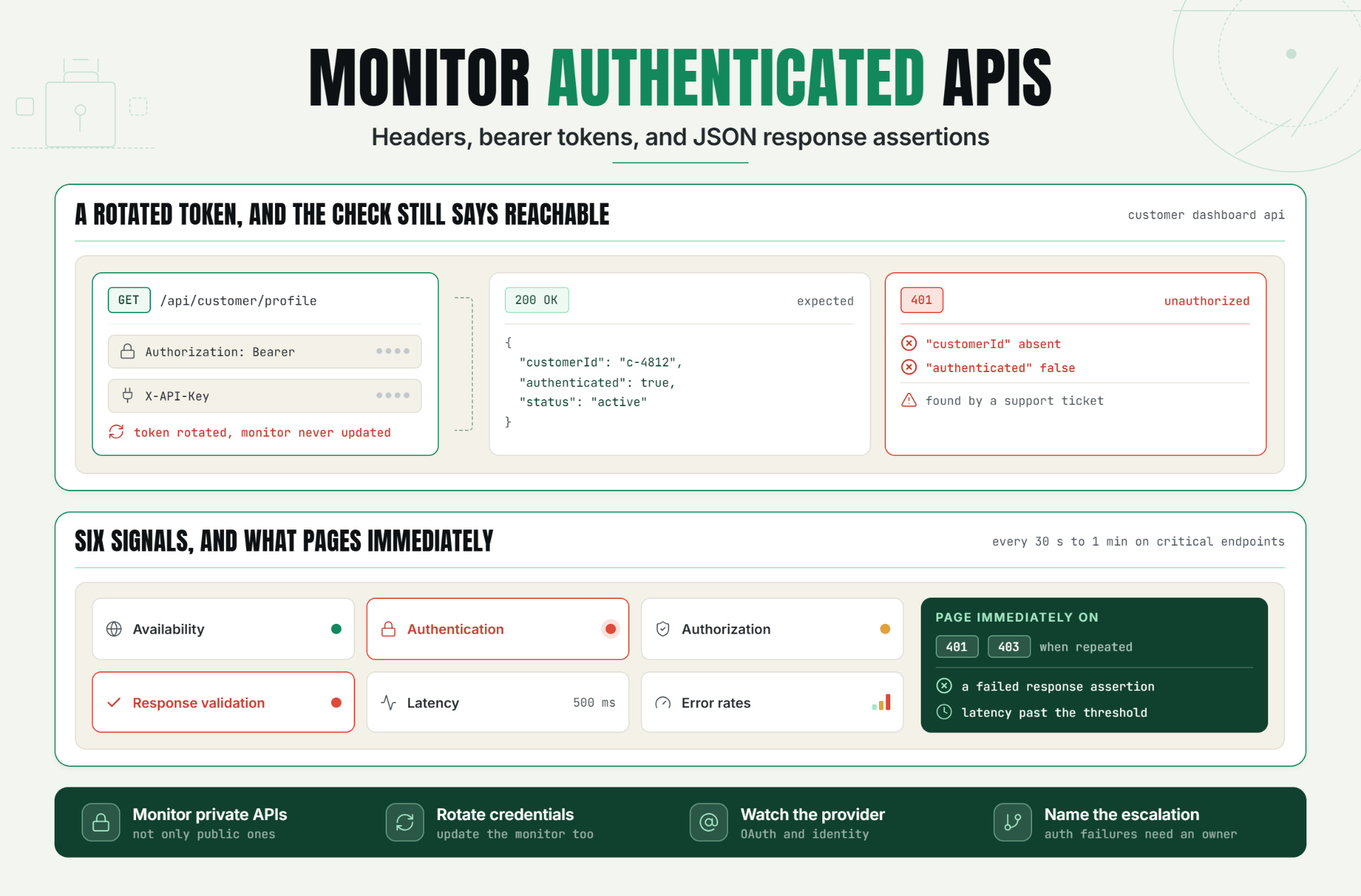
Many modern APIs are private and protected by authentication mechanisms such as API keys, bearer tokens, OAuth credentials, and custom headers. While basic uptime checks can verify endpoint availability, they often fail to validate whether authenticated workflows are functioning correctly.
An API may appear healthy while authentication systems fail, access tokens expire, permissions change, or application responses become invalid. These issues can impact customers long before engineering teams become aware of the problem.
Authenticated API monitoring helps teams verify not only endpoint availability but also authentication, authorization, response validation, and business-critical functionality.
The Operational Risks Teams Face Without Effective Authenticated API Monitoring
Many organizations monitor only public endpoints while assuming authenticated services will continue working normally.
Without authenticated API monitoring, teams risk:
- Expired authentication tokens.
- Broken authorization workflows.
- Failed API key validation.
- Permission-related outages.
- Invalid API responses.
- Authentication provider failures.
- Customer-facing service disruptions.
Basic uptime checks may continue reporting success while customers are unable to access critical services.
How Authenticated API Monitoring Works, Key Signals, Thresholds, and Diagnosis
What Is Authenticated API Monitoring?
Authenticated API monitoring validates private API endpoints that require authentication before access is granted.
Unlike public endpoint monitoring, authenticated monitoring verifies credentials, permissions, and application responses.
Monitoring APIs with Bearer Tokens
Many APIs use bearer tokens for authentication.
Example header:Authorization: Bearer <token>Monitoring tools should include valid tokens when performing checks against protected endpoints.
Monitoring APIs with Custom Headers
Some services require custom authentication headers.
Example:X-API-Key: your-api-keyMonitors should validate both authentication success and endpoint functionality.
JSON Response Assertions
Status codes alone are not enough.
An API can return200 OK while returning incorrect application data. JSON assertions verify that expected values exist in responses.
Example assertion:"status":"active" Example assertion: "authenticated":trueAuthentication Failure Detection
Effective monitoring should detect:
- 401 Unauthorized
- 403 Forbidden
- Expired tokens
- Permission changes
- OAuth failures
- Identity provider outages
Key Signals to Monitor
| Signal | Purpose |
|---|---|
| Availability | Verify endpoint accessibility |
| Authentication Success | Validate credentials |
| Authorization | Verify permissions |
| Response Validation | Confirm expected payloads |
| Latency | Monitor performance |
| Error Rates | Track failures |
Recommended Alert Thresholds
- Immediate alert on repeated 401 responses.
- Immediate alert on repeated 403 responses.
- Alert when latency exceeds defined thresholds.
- Alert when response assertions fail.
A Realistic Production Scenario and Recommended Monitor Setup
Scenario: Customer Dashboard API
A SaaS application exposes a private customer dashboard endpoint.
Endpoint:GET /api/customer/profileThe API requires a bearer token and returns customer account information.
The Incident
A recently rotated token becomes invalid.
Customers begin receiving authentication errors.
Response:401 UnauthorizedWithout authenticated monitoring, the issue may go unnoticed until customers submit support tickets.
Recommended Monitor Setup
| Monitor Type | Purpose |
|---|---|
| Availability Check | Verify endpoint accessibility |
| Bearer Token Validation | Verify authentication |
| Header Validation | Confirm request configuration |
| JSON Assertions | Verify response correctness |
| Latency Monitoring | Track performance |
Example Assertions
- Expected field: "customerId"
- Expected value: "authenticated":true
- Maximum latency: 500ms
Best Practices: Coverage, Check Frequency, Validation, Ownership, and Escalation
1. Monitor Critical Authenticated Endpoints
Focus on APIs directly affecting customer access and business operations.
2. Validate Authentication and Authorization
Verify both login success and permission-based access.
3. Use JSON Response Assertions
Validate response content instead of relying solely on status codes.
4. Rotate Credentials Securely
Update monitoring credentials when tokens or API keys change.
5. Monitor Frequently
Critical APIs should typically be checked every 30 seconds to 1 minute.
6. Monitor Authentication Providers
Track dependencies such as OAuth providers and identity services.
7. Define Escalation Ownership
Ensure authentication failures reach responsible teams quickly.
Common Mistakes: Weak Checks, Noisy Alerts, Missing Dependencies, and Poor Routing
Mistake 1: Monitoring Only Public Endpoints
Better approach: Monitor private authenticated APIs.
Mistake 2: Ignoring Response Validation
Better approach: Use JSON assertions.
Mistake 3: Using Expired Tokens
Better approach: Maintain secure credential rotation processes.
Mistake 4: Monitoring Only Status Codes
Better approach: Validate business-critical response fields.
Mistake 5: Ignoring Authentication Dependencies
Better approach: Monitor identity providers and authorization services.
Reliable Private APIs Require More Than Basic Uptime Checks
Authenticated API monitoring provides visibility into authentication, authorization, response validation, and endpoint performance.
By monitoring headers, bearer tokens, and JSON assertions, teams can detect issues before they affect customers and business operations.
The first step is identifying your most critical authenticated endpoints and implementing validation beyond simple availability checks.
Start Monitoring Your Authenticated APIs
Ready to validate private APIs with headers, tokens, and response assertions?
Start your 30-day Statixoup trial and configure your first authenticated API monitor.
Monitor authentication workflows, validate API responses, and detect failures before customers experience disruptions.