Monitor DNS Changes for Security: Catch Hijacking, Misconfigurations, and Unauthorized Updates
No breach, no cracked password just one quietly changed DNS record, and suddenly customer emails are landing in an attacker's inbox. Learn how DNS change monitoring catches hijacking and unauthorized updates before the damage spreads.
No firewall was breached. No password was cracked in front of anyone. A single MX record changed, quietly, at a domain registrar and from that moment on, every password reset email for the company's customers was landing in an attacker's inbox instead.
This is the uncomfortable truth about DNS: it's rarely the target of a dramatic hack. It's usually the target of a quiet, boring looking change that nobody was watching for. DNS change monitoring exists because the DNS layer is one of the highest leverage places an attacker can touch and one of the least watched.
Anatomy of a DNS Attack: The Timeline Nobody Sees Coming
Most DNS security incidents don't look dramatic in the moment. They look like this:
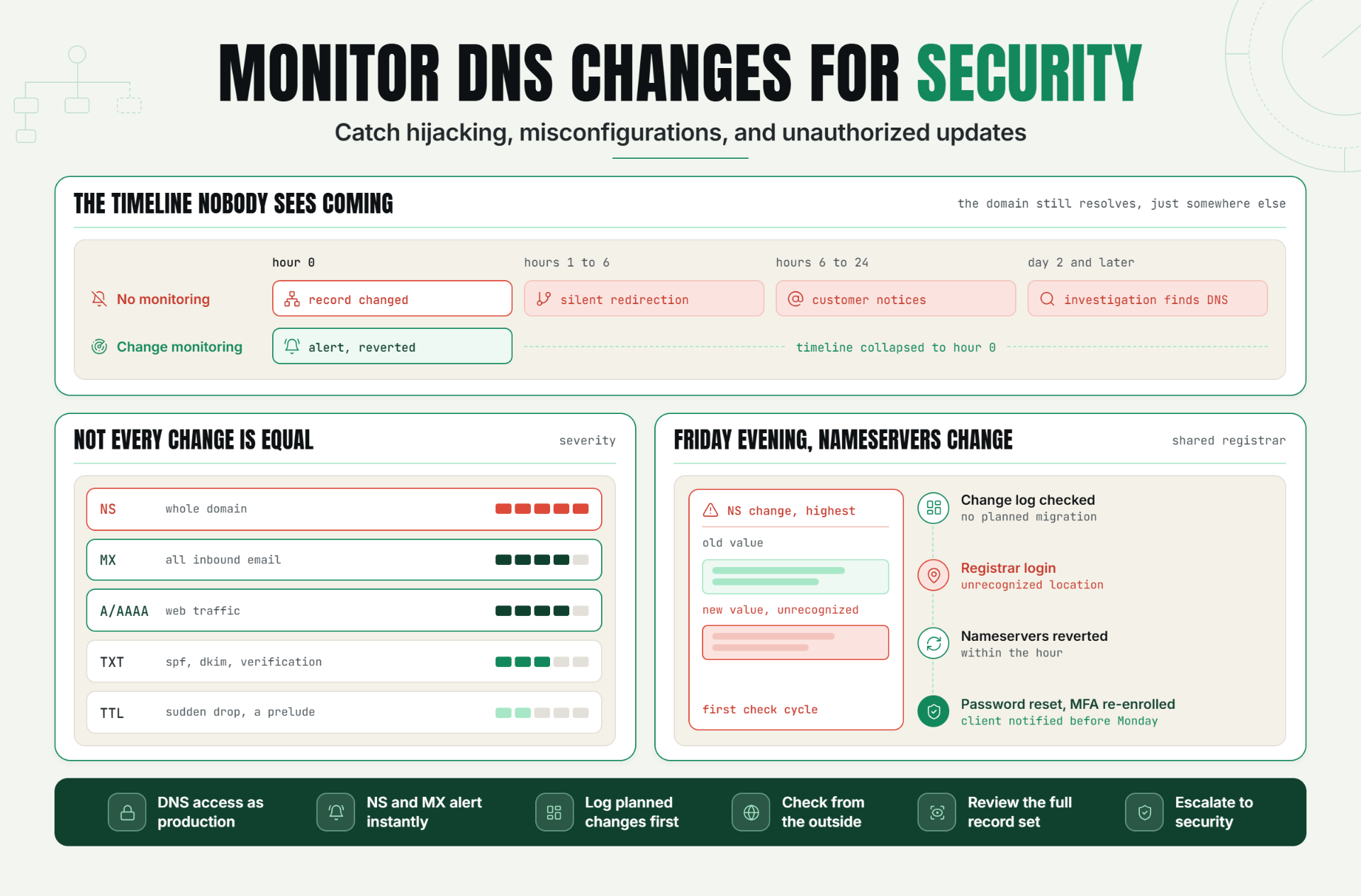
Hour 0 — The change happens. An attacker gains access to a registrar account (often through a phished credential, a reused password, or a support-desk social engineering call) and changes a nameserver, an A record, or an MX record. No alarms go off, because nothing "broke" the domain still resolves, just to somewhere different.
Hours 1–6 — Silent redirection. Traffic, email, or both begin flowing to infrastructure the attacker controls. A DNS hijack often doesn't take a site offline it keeps it looking normal while quietly rerouting trust fake login pages, intercepted emails, forged SSL certificates issued against the hijacked domain.
Hours 6–24 — Someone notices something's off. A customer reports a suspicious login page. A password reset email never arrives. An engineer notices SSL certificate warnings that shouldn't be there. By this point, real damage credential theft, data exposure, reputational harm may already be done.
Day 2+ — The investigation finally reaches DNS. After ruling out the server, the application, and the hosting provider, someone finally checks the actual DNS records and finds the change. The fix itself often takes minutes. Finding it took a day or more.
DNS change monitoring exists to collapse that entire timeline down to Hour 0 flagging the unauthorized change the moment it happens, not a day later during a forensic review.
Why This Matters Beyond Uptime
Most teams think about DNS monitoring in terms of availability is the domain resolving, is the site reachable. That framing misses half the risk. DNS isn't just a routing layer; it's a trust layer. Every SSL certificate issuance, every email delivery, every OAuth redirect, and every "forgot password" flow implicitly trusts that your DNS records point where you intend them to.
Domain security starts with the assumption that DNS records are static and correct between the moments you deliberately change them. An attacker who can quietly alter that assumption doesn't need to break into your servers at all they just need your domain to point somewhere else for a few hours.
The Real Risk: DNS as an Attack Surface, Not Just an Availability Layer
A few reasons DNS is a uniquely attractive and under defended target:
- It's often managed outside your security perimeter. Registrar and DNS provider accounts frequently sit outside the same access controls, MFA policies, and monitoring applied to internal infrastructure.
- A single credential compromise goes a long way. Access to one registrar login can redirect an entire domain no need to compromise individual servers, applications, or employee accounts one by one.
- Changes look legitimate by design. DNS records are supposed to change occasionally. A malicious update to an A record looks identical, at a glance, to a routine infrastructure migration.
- The damage compounds through trust, not just downtime. A hijacked domain can be used to intercept email, issue fraudulent SSL certificates via domain validation, or host convincing phishing pages all while looking, to a casual glance, like your real site or mail server.
Without DNS security monitoring, most organizations only discover an unauthorized DNS change through its downstream effects a customer complaint, a security researcher's report, or a certificate transparency log alert rather than the change itself.
How DNS Change Monitoring Actually Works
At its core, this works the same way file integrity monitoring works for a server: establish a known good baseline, then flag any deviation from it immediately, treating every unexpected change as suspicious until proven otherwise.
The baseline. A documented snapshot of every DNS record currently in use A, AAAA, MX, NS, TXT, CNAME for the domain and its subdomains, along with who is authorized to change each one and why.
The comparison. Continuous, scheduled queries against the live DNS records, compared against that baseline on every check cycle.
The classification. Not every change is equally dangerous. A well designed system for DNS hijacking detection treats these differently:
- Nameserver (NS) changes — highest severity, since this can redirect resolution for the entire domain regardless of what individual records say.
- MX record changes — high severity, since this silently redirects all inbound email.
- A/AAAA record changes — high severity for production domains, since this redirects web traffic.
- TXT record changes — moderate severity; often used for SPF/DKIM and domain verification, so a change here can quietly break email authentication or hand a third party proof of "ownership."
- TTL changes — lower severity on their own, but worth flagging since a sudden TTL drop right before another change can be a sign someone is preparing for a fast, temporary redirect.
The alert. Every one of these should generate a nameserver change alert (or equivalent record specific alert) immediately, with enough detail what changed, from what value, to what value, and when to let a human quickly judge whether it was planned or not.
Red Flags: Signs of a DNS Hijacking or Unauthorized Change
If you're reviewing your DNS setup right now, these are the specific signs worth checking for:
- A nameserver listed for your domain that nobody on your team recognizes or can explain.
- An MX record pointing to a mail server outside your known email provider, especially one that appeared without a corresponding planned migration.
- SSL certificate warnings or unexpected certificate issuance notices for your domain that your team didn't request.
- A sudden, unexplained drop in TTL shortly before other records changed.
- Login or password-reset emails that customers report never receiving, especially in a cluster around the same time period.
- A domain registrar login notification from an unfamiliar location or device that nobody flagged as suspicious at the time.
- DNS records that were "corrected" back to their expected value without anyone on the team remembering having changed them in the first place.
Any one of these in isolation might be nothing. Two or more together, especially close in time, deserve an immediate manual review of every DNS record for the domain.
A Practical Production Scenario
An agency manages DNS for several ecommerce clients through a shared registrar account. One client's domain has its nameservers changed late on a Friday evening a low traffic, low attention window that gives a malicious change more time to sit unnoticed over a weekend.
Because the agency has DNS change monitoring configured with nameserver changes flagged as highest severity, an alert fires within the first check cycle after the change well before Monday morning. The alert names the exact domain, the old nameservers, and the new ones now listed.
The on call team member cross checks the agency's change log: no planned nameserver migration is scheduled for this client. Within the hour, they confirm the registrar account shows a login from an unrecognized location, revert the nameserver change, force a password reset with MFA reenrollment on the account, and notify the client.
Without this alert, the same change likely wouldn't have surfaced until Monday, when the client's team noticed their site was serving different content by which point the domain could have been pointed at a phishing clone for the entire weekend.
Recommended Monitor Setup
- Document a baseline of every DNS record in use, including subdomains, and who is authorized to change each type.
- Monitor nameserver and MX records as highest priority, immediate alert categories.
- Log every planned DNS change in advance, so alerts can be quickly confirmed as expected or flagged as suspicious.
- Enable MFA on every registrar and DNS provider account, separate from general infrastructure security policies.
- Cross reference DNS alerts with registrar account login activity when something unexpected appears.
- Review the full record set periodically, not just wait for alerts a subtle, well disguised change can sometimes evade a narrow comparison rule.
Best Practices for DNS Security Monitoring
Treat DNS access like production infrastructure access. Registrar and DNS provider logins should carry the same MFA requirements, access reviews, and offboarding discipline as your servers and cloud accounts not looser controls just because DNS "isn't a server."
Alert immediately on nameserver and MX changes, no exceptions. These carry outsized blast radius compared to other record types, and a delayed or batched alert defeats the purpose entirely.
Log every planned change before you make it. A documented change log turns "is this alert a real threat?" into a ten second lookup instead of a full investigation every time.
Monitor from the outside, not just from internal access logs. Registrar login logs can be tampered with or simply missed; an independent DNS check confirms what's actually live and resolvable, regardless of what any internal log claims.
Review your full DNS record set on a schedule, not just reactively. Waiting only for alerts assumes every malicious change will trip a rule a periodic manual review catches subtler, well disguised changes that automated comparisons might miss.
Escalate DNS alerts to security, not just ops. A DNS record change is as much a potential security incident as an infrastructure event, and routing it only to an on call ops rotation can mean it's treated as a routine glitch instead of a possible compromise.
Common Mistakes That Leave DNS Exposed
Assuming DNS security is the registrar's job. Registrars provide the infrastructure, they don't monitor whether your specific records match what you actually intend. That responsibility sits with you.
Applying weaker access controls to DNS accounts than to servers. A registrar login is often more consequential than access to any single server, yet frequently receives less security attention.
Treating every DNS change alert the same way. A TXT record update and a nameserver change are not equally urgent. Flat, undifferentiated alerting either causes alert fatigue or under reacts to the changes that matter most.
Not maintaining a change log. Without one, every legitimate change looks exactly like a suspicious one, and every alert requires a full investigation from scratch.
Only monitoring from internal logs, not external resolution. Internal access logs can miss changes made through compromised credentials that never triggered suspicious internal activity. Checking the live, external DNS record itself closes that gap.
Routing DNS alerts only to infrastructure teams. A hijacked domain is a security incident, not just an availability one it needs a path to security response, not only an ops on call rotation.
Start Watching Your DNS Like a Security Layer
DNS doesn't fail loudly. It fails quietly, looking correct right up until someone notices it isn't and by then, the trust it was supposed to protect may already be compromised.
Start a 30 day Statixoup free trial and configure DNS change monitoring across your records and nameservers, with immediate alerts on the changes that matter most. The next unauthorized change won't wait for someone to notice you'll know the moment it happens.