Multi-Location Uptime Monitoring: Why One Check Location Is Not Enough
Learn why a website can appear healthy from one region while users in another experience outages. Discover how multi-location uptime monitoring helps detect regional failures, CDN issues, DNS problems, and network disruptions before they impact customers.
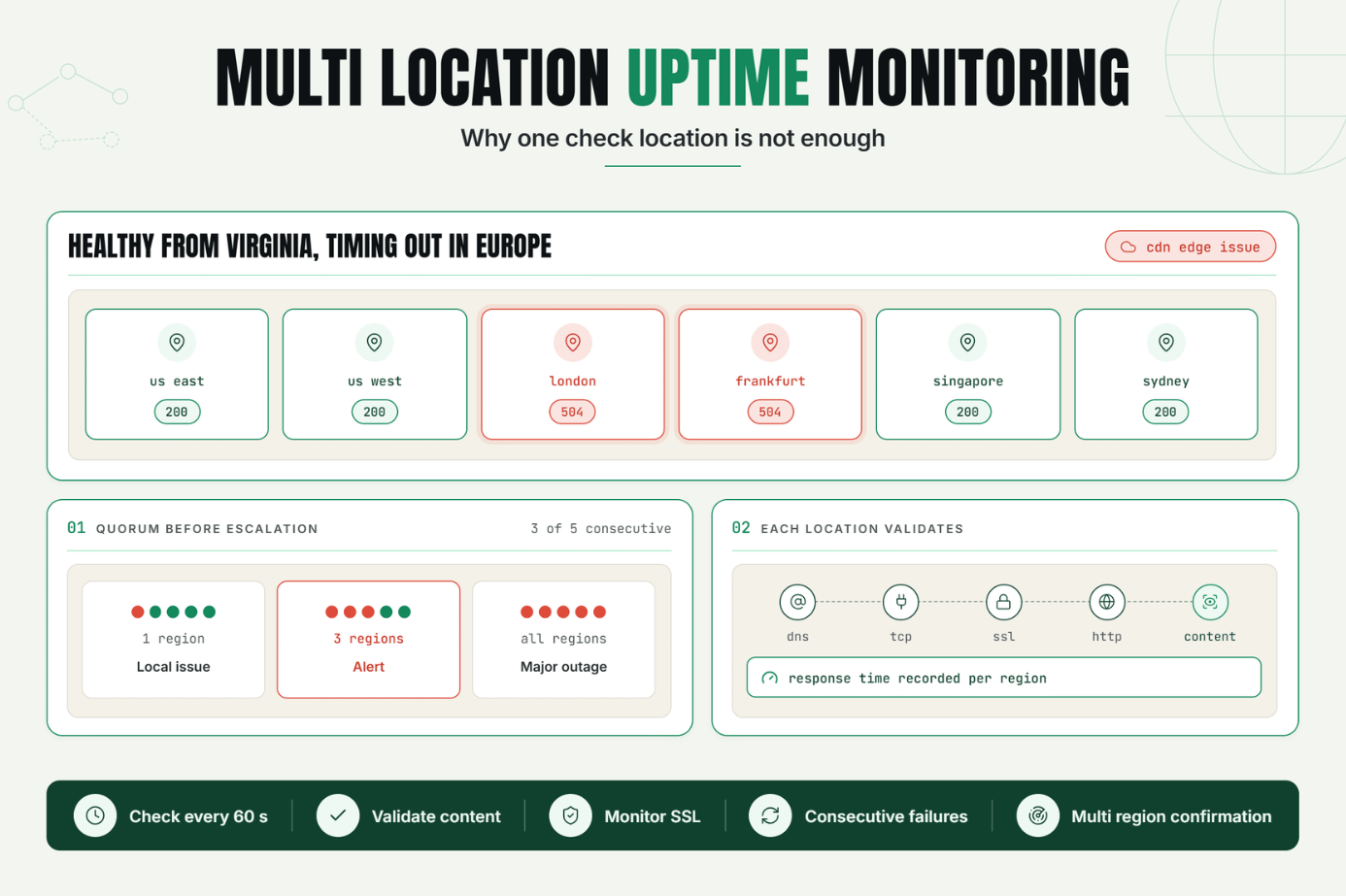
A website may appear fully operational from one region while users in another part of the world experience outages, slowdowns, or connectivity issues. Traditional uptime monitoring often relies on a single monitoring location, which can create blind spots and leave teams unaware of regional failures affecting real customers.
Multi-location uptime monitoring addresses this challenge by checking website availability from multiple geographic regions. Instead of relying on a single perspective, organizations gain a broader view of network availability, CDN performance, DNS resolution, and application health across different locations.
For global SaaS businesses, ecommerce platforms, agencies, and DevOps teams, regional visibility is no longer optional. Customers expect reliable access regardless of where they are located.
The Operational Risks Teams Face Without Effective Multi-Location Uptime Monitoring
Many organizations assume their website is healthy because monitoring checks from one location report success.
Unfortunately, customers may experience a completely different reality.
Without multi-location monitoring, teams risk:
- Missing regional outages affecting specific countries or continents.
- Failing to detect CDN routing problems before customers complain.
- Overlooking DNS propagation issues across geographic regions.
- Missing ISP-related network failures that impact users but not monitors.
- Generating false positives caused by localized connectivity issues.
- Delaying incident response for geographically isolated outages.
- Damaging customer experience in important markets.
A website that works in one region can fail in another. A successful check from a single location does not guarantee global availability.
How Multi-Location Uptime Monitoring Works
What Is Multi-Location Uptime Monitoring?
Multi-location uptime monitoring performs availability checks from multiple geographic regions instead of relying on a single monitoring node.
Monitoring systems deploy agents across different global locations and perform regular checks against a website or API.
Each location independently validates:
- DNS resolution
- TCP connectivity
- SSL/TLS negotiation
- HTTP responses
- Response times
- Content validation
- Network availability
The combined results provide a more accurate view of real-world availability.
Why Single-Location Monitoring Creates Blind Spots
A monitor in US-East may successfully access a website while users in Asia-Pacific experience routing failures.Because the monitoring location and affected users follow different network paths, the issue remains undetected.
Common Regional Failure Scenarios
CDN Outages
A CDN edge location may fail while the origin server remains healthy.
Customers connected to the affected edge location experience problems, while monitoring from another region reports success.
DNS Resolution Problems
A domain may resolve successfully in North America but fail in Europe.
Without geographically distributed monitoring, teams may never see the failure.
ISP Routing Problems
Internet providers occasionally experience routing issues affecting specific regions.
These failures often impact customer traffic while leaving centralized monitoring unaffected.
Cloud Provider Network Events
Cloud regions can occasionally experience degraded performance or partial outages.
Multi-location monitoring helps identify whether the issue is local or global.
Key Signals to Monitor
| Signal | Purpose |
|---|---|
| Availability | Confirm endpoint accessibility |
| Response Time | Detect regional latency issues |
| DNS Resolution | Identify regional DNS failures |
| SSL/TLS Validation | Verify certificate health |
| HTTP Status Codes | Detect application errors |
| Content Validation | Confirm correct page rendering |
| Network Connectivity | Detect routing failures |
Alert Thresholds and Validation
Not every failed location should trigger a critical incident.
- One failed region may indicate a localized network issue.
- Multiple failed regions may indicate a broader outage.
- All regions failing usually indicates a major service disruption.
This approach reduces false positives while maintaining fast outage detection.
A Realistic Production Scenario and Recommended Monitor Setup
Consider a SaaS company serving customers across North America, Europe, and Asia.
Initial Monitoring Setup
The company monitors only from Virginia.
- Homepage returns successfully
- HTTP response is valid
- Response time appears normal
The monitoring system reports healthy status.
Customer Complaints Begin
European customers suddenly report:
- Login failures
- Slow page loads
- Connection timeouts
Investigation reveals a CDN edge issue affecting European traffic.
Because monitoring existed only in Virginia, the outage went undetected.
Recommended Global Monitor Setup
| Location | Purpose |
|---|---|
| US East | North America coverage |
| US West | Additional regional validation |
| London | Europe coverage |
| Frankfurt | Central Europe coverage |
| Singapore | Asia-Pacific coverage |
| Sydney | Oceania coverage |
Example Monitoring Rules
- Check every 60 seconds
- Validate HTTP response
- Validate expected content
- Monitor SSL certificates
- Alert after consecutive failures
- Require multi-region confirmation
Example Failure Diagnosis
Users in Europe receive 504 Gateway Timeout responses while other regions remain healthy.Multi-location monitoring immediately reveals the affected regions and helps engineers isolate the issue faster.
Best Practices: Coverage, Check Frequency, Validation, Ownership, and Escalation
1. Monitor From Regions Where Customers Are Located
Monitoring locations should reflect actual customer distribution.
2. Use Multiple Continents
Global services should monitor from North America, Europe, and Asia-Pacific at minimum.
3. Combine Availability and Content Validation
Availability alone does not guarantee functionality.
4. Configure Sensible Alert Thresholds
Use quorum-based alerting instead of reacting to isolated failures.
5. Monitor Critical Business Workflows
- Homepage
- Login
- Checkout
- Payment APIs
- Customer dashboards
6. Define Clear Ownership
Every alert should have a designated owner and escalation path.
7. Review Coverage Regularly
Monitoring locations should evolve as customer distribution changes.
Common Mistakes: Weak Checks, Noisy Alerts, Missing Dependencies, and Poor Routing
Mistake 1: Monitoring From Only One Location
Better approach: Use geographically distributed monitoring locations.
Mistake 2: Ignoring CDN Dependencies
Better approach: Monitor traffic paths that use different CDN edges.
Mistake 3: Alerting on Every Regional Failure
Better approach: Use multi-location validation before triggering incidents.
Mistake 4: Monitoring Only the Homepage
Better approach: Monitor critical business workflows.
Mistake 5: Ignoring DNS Health
Better approach: Include DNS monitoring alongside uptime checks.
Mistake 6: Poor Escalation Processes
Better approach: Define routing, ownership, and escalation procedures.
Global Visibility Creates More Reliable Monitoring
Multi-location uptime monitoring provides a more accurate picture of website health than single-location monitoring.
By validating availability from multiple regions, organizations can detect CDN failures, DNS issues, routing problems, and regional outages before they impact customers.
The first step is simple: identify where your customers are located and ensure your monitoring strategy reflects their experience—not just your own.
Start Monitoring From Multiple Locations
Ready to detect regional outages before your customers do?
Start your 30-day Statixoup trial and configure your first multi-location monitor.
Monitor your website from global locations, validate critical services, and receive faster, more accurate alerts when availability problems occur.