Response Header Monitoring: Track Cache, Security, and Content-Type Changes
Learn how HTTP header monitoring helps detect configuration drift, missing security headers, cache-control issues, and unexpected content-type changes before they impact performance, security, SEO, or customer experience.
HTTP response headers provide critical information about how browsers, search engines, APIs, CDNs, and security systems interact with your website or application. While most teams focus on uptime and response codes, important configuration changes often occur within response headers.
A missing security header, incorrect cache setting, or unexpected content type can introduce security risks, degrade performance, break integrations, and negatively affect SEO.
HTTP header monitoring helps teams continuously validate important response headers and detect configuration drift before it impacts customers or business operations.
Whether you manage websites, APIs, SaaS platforms, or enterprise applications, monitoring response headers provides an additional layer of visibility beyond basic uptime checks.
The Operational Risks Teams Face Without Effective HTTP Header Monitoring
Many production incidents occur even though websites continue responding successfully.
Without HTTP header monitoring, organizations may face:
- Missing security protections.
- Broken caching behavior.
- SEO indexing issues.
- API integration failures.
- Content delivery problems.
- Unexpected browser behavior.
- Configuration drift after deployments.
Because these issues often occur without downtime, they can remain undetected for days or weeks.
Traditional uptime monitoring typically cannot identify header-level changes.
How HTTP Header Monitoring Works, Key Signals, Thresholds, and Diagnosis
What Is HTTP Header Monitoring?
HTTP header monitoring continuously validates response headers returned by websites and APIs to ensure important configuration settings remain correct.
Monitoring systems compare expected values against actual responses and trigger alerts when unexpected changes occur.
Security Header Monitoring
Security headers help protect websites from common attacks.
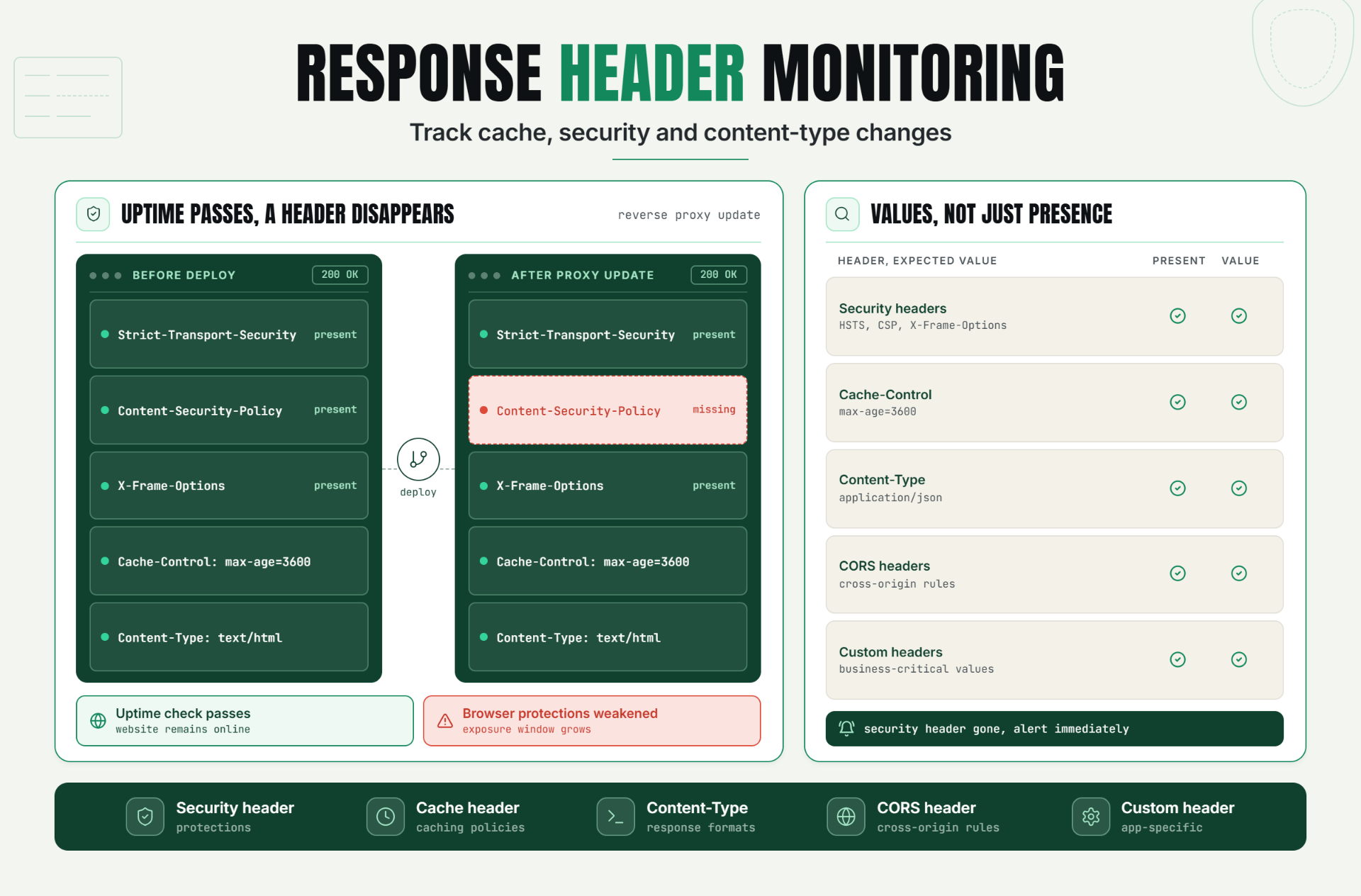
Example header: Strict-Transport-Security Example header: Content-Security-Policy Example header: X-Frame-OptionsIf these headers disappear after a deployment, security risks can increase immediately.
Cache-Control Validation
Caching headers directly affect performance and content freshness.
Example value: Cache-Control: max-age=3600Unexpected changes may cause stale content, CDN issues, or excessive server load.
Content-Type Monitoring
Applications should return expected content types.
Expected value: Content-Type: application/json Expected value: Content-Type: text/htmlIncorrect content types can break APIs, browsers, integrations, and search engine processing.
Key Signals to Monitor
| Header Type | Purpose |
|---|---|
| Security Headers | Protect applications |
| Cache Headers | Control caching behavior |
| Content-Type | Validate response format |
| CORS Headers | Control cross-origin access |
| Custom Headers | Validate application behavior |
Recommended Alert Thresholds
- Alert immediately when security headers disappear.
- Alert when cache-control values change unexpectedly.
- Alert when content-type values differ from expectations.
- Alert on CORS configuration changes.
- Alert when custom business-critical headers change.
A Realistic Production Scenario and Recommended Monitor Setup
Scenario: Missing Security Header After Deployment
An engineering team deploys a reverse proxy configuration update.
During deployment, a configuration error removes an important security header.
Missing header: Content-Security-PolicyThe website remains online and passes uptime checks, but browser protections are weakened.
The Business Impact
- Increased security risk.
- Compliance concerns.
- Potential customer trust issues.
- Delayed incident detection.
- Extended exposure window.
Recommended Monitor Setup
| Monitor Type | Purpose |
|---|---|
| Security Header Monitor | Validate security protections |
| Cache Header Monitor | Verify caching policies |
| Content-Type Monitor | Validate response formats |
| CORS Header Monitor | Monitor cross-origin rules |
| Custom Header Monitor | Track application-specific headers |
This monitoring strategy helps teams detect configuration drift before it affects customers or security posture.
Best Practices: Coverage, Check Frequency, Validation, Ownership, and Escalation
1. Monitor Critical Security Headers
Prioritize headers that directly affect security and compliance.
2. Validate Cache Policies
Ensure caching behavior remains consistent after deployments.
3. Monitor API Content Types
Verify that APIs return expected response formats.
4. Check Header Values, Not Just Presence
Incorrect values can be just as harmful as missing headers.
5. Monitor Production Continuously
Configuration drift can occur at any time.
6. Define Ownership
Assign responsibility for header-related alerts and remediation.
7. Establish Escalation Procedures
Route critical configuration changes to the correct teams immediately.
Common Mistakes: Weak Checks, Noisy Alerts, Missing Dependencies, and Poor Routing
Mistake 1: Monitoring Status Codes Only
Better approach: Validate important response headers.
Mistake 2: Checking Header Presence Only
Better approach: Verify expected values.
Mistake 3: Ignoring Cache Headers
Better approach: Monitor cache-control policies continuously.
Mistake 4: Missing Security Header Validation
Better approach: Alert immediately when critical protections disappear.
Mistake 5: Poor Alert Ownership
Better approach: Route alerts directly to responsible engineering teams.
Reliable Applications Require HTTP Header Monitoring
Response headers influence security, performance, SEO, application behavior, and customer experience.
By validating security policies, cache settings, content types, and custom headers, teams can detect configuration drift before it becomes a production incident.
The first step is implementing HTTP header monitoring that verifies both header presence and expected values across critical services.
Start Monitoring HTTP Headers Today
Ready to detect configuration drift, missing security headers, cache issues, and unexpected response changes before they impact customers?
Start your 30-day Statixoup beta and configure HTTP header monitoring for your most important websites and APIs.
Validate critical response headers, improve reliability, and strengthen security with proactive monitoring.