REST API Monitoring Checklist for Production Teams
Use this REST API monitoring checklist to ensure your production APIs remain reliable, fast, and available. Learn which endpoints to monitor, what assertions to validate, and how to detect failures before they affect customers.
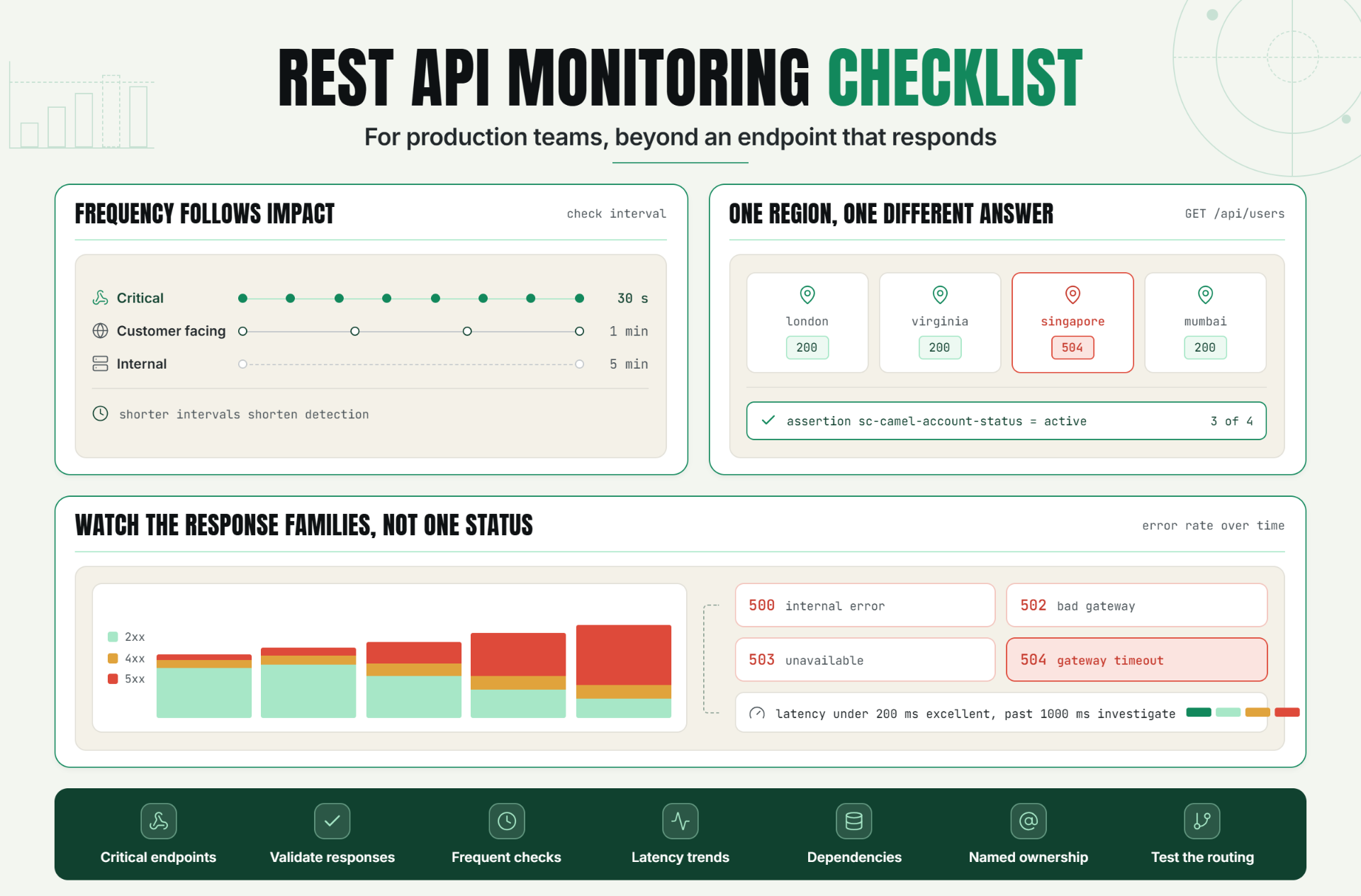
REST APIs power modern applications, mobile apps, customer portals, integrations, and business-critical workflows. When an API becomes unavailable, slow, or returns incorrect responses, users immediately feel the impact.
Unfortunately, many teams deploy APIs into production without a comprehensive monitoring strategy. Simply checking whether an endpoint responds is rarely enough to guarantee reliability.
A structured REST API monitoring checklist helps teams validate availability, performance, response correctness, dependencies, and user experience before issues become customer-facing incidents.
The Operational Risks Teams Face Without Effective REST API Monitoring Checklist
Production APIs often fail in ways that basic uptime checks cannot detect.
Without a monitoring checklist, teams risk:
- Undetected endpoint failures.
- Slow response times affecting customers.
- Broken authentication workflows.
- Incorrect API responses.
- Database dependency failures.
- Missed SLA targets.
- Longer incident resolution times.
Monitoring only for availability leaves significant gaps in visibility and reliability.
How REST API Monitoring Checklist Works, Key Signals, Thresholds, and Diagnosis
The Production REST API Monitoring Checklist
1. Monitor API Availability
Every critical endpoint should be monitored for uptime and accessibility.
Example endpoint:GET /api/usersVerify that requests successfully reach the service and return expected responses.
2. Validate HTTP Status Codes
Monitor unexpected responses such as:
- 500 Internal Server Error
- 502 Bad Gateway
- 503 Service Unavailable
- 504 Gateway Timeout
3. Verify Response Content
A successful response should contain expected values.
Expected field:"status":"success"Response validation helps detect application-level failures that status-code monitoring misses.
4. Monitor API Response Time
| Response Time | Status |
|---|---|
| Less than 200 ms | Excellent |
| 200 - 500 ms | Acceptable |
| 500 - 1000 ms | Needs attention |
| More than 1000 ms | Investigate immediately |
5. Validate Authentication
Monitor authentication endpoints and token generation workflows.
Example:POST /api/login6. Monitor API Health Endpoints
Track readiness and health endpoints.
Example:/health7. Monitor Dependencies
REST APIs commonly depend on:
- Databases
- Payment providers
- Cloud storage services
- Identity providers
- Third-party APIs
8. Monitor Error Rates
Track increases in:
- 4xx responses
- 5xx responses
- Timeouts
9. Configure API Assertions
Assertions verify expected behavior.
Example assertion: accountStatus = active10. Monitor From Multiple Locations
Global users may experience regional failures that a single monitoring location cannot detect.
A Realistic Production Scenario and Recommended Monitor Setup
Imagine a SaaS application that provides customer account data through REST APIs.
The Incident
The endpoint returns 200 OK but database queries fail internally.Users receive incomplete account information while uptime monitoring continues reporting success.
Recommended Production Monitor Setup
| Monitor | Purpose |
|---|---|
| Availability Check | Endpoint accessibility |
| Response Validation | Verify payload correctness |
| Latency Monitoring | Track performance degradation |
| Health Endpoint Check | Validate readiness |
| Dependency Monitoring | Monitor databases and services |
Recommended Monitoring Frequency
- Critical APIs: Every 30 seconds
- Customer-facing APIs: Every minute
- Internal APIs: Every 5 minutes
Best Practices: Coverage, Check Frequency, Validation, Ownership, and Escalation
1. Monitor Business-Critical Endpoints
Focus on APIs that directly impact customers and revenue.
2. Validate Responses Beyond Status Codes
Check response content and business logic.
3. Use Frequent Monitoring
Short intervals improve incident detection.
4. Track Performance Trends
Monitor latency before users notice slowdowns.
5. Monitor Dependencies
Database and third-party failures often cause API incidents.
6. Define Ownership
Every monitor should have a responsible team.
7. Test Alert Routing
Ensure alerts reach the correct responders.
Common Mistakes: Weak Checks, Noisy Alerts, Missing Dependencies, and Poor Routing
Mistake 1: Monitoring Only Availability
Better approach: Add response validation and assertions.
Mistake 2: Ignoring Authentication Endpoints
Better approach: Monitor login and token generation workflows.
Mistake 3: Not Monitoring Dependencies
Better approach: Include databases and third-party providers.
Mistake 4: Using Long Check Intervals
Better approach: Monitor critical APIs every 30-60 seconds.
Mistake 5: Poor Alert Ownership
Better approach: Define escalation paths and responsibilities.
Reliable APIs Require More Than Basic Availability Checks
A strong REST API monitoring checklist helps teams detect issues faster, reduce downtime, and improve customer experience.
By monitoring availability, latency, response validation, dependencies, and assertions, organizations gain deeper visibility into API health and performance.
The first step is identifying your critical endpoints and implementing comprehensive monitoring beyond simple uptime checks.
Start Monitoring Your REST APIs Today
Ready to improve API reliability and detect issues before customers notice?
Start your 30-day Statixoup trial and configure your first REST API monitor.
Validate API responses, monitor performance, and gain complete visibility into your production services.