How to Monitor Third-Party APIs and SaaS Dependencies
Learn how third-party API monitoring helps detect vendor outages, integration failures, and SaaS dependency issues before they impact customers. Discover best practices for monitoring external APIs, validating responses, and reducing operational risk.
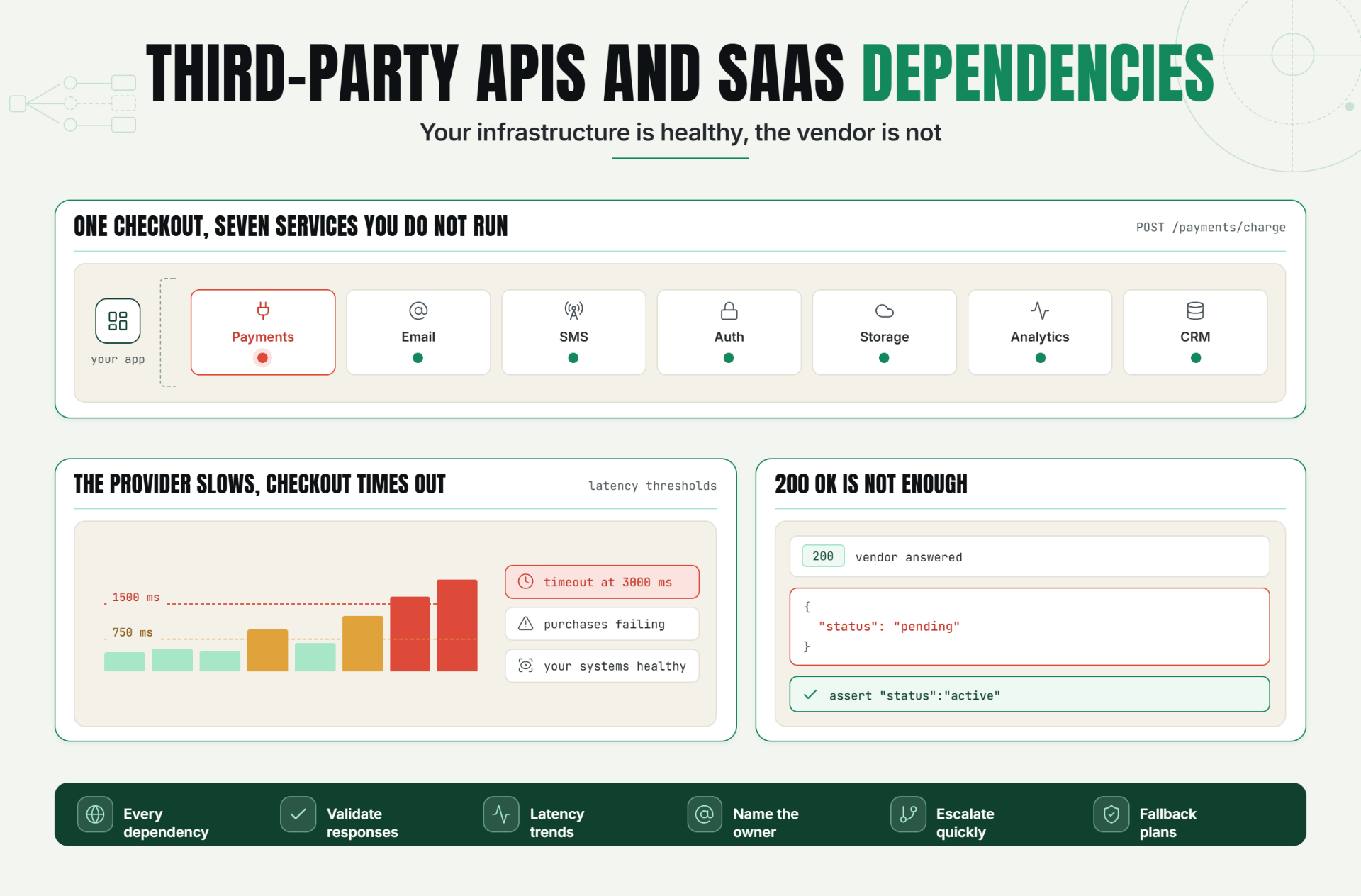
Modern applications rarely operate in isolation. Most SaaS platforms depend on external APIs and third-party services for payments, authentication, communications, analytics, storage, and other critical business functions.
While these integrations accelerate development, they also introduce operational risk. A single vendor outage can disrupt customer experiences even when your own infrastructure remains healthy.
Third-party API monitoring helps teams detect vendor issues early, validate integrations continuously, and reduce the impact of external service failures.
The Operational Risks Teams Face Without Effective Third-Party API Monitoring
External APIs often become critical parts of application architecture. When a vendor experiences downtime or degraded performance, customers frequently blame the application rather than the third-party provider.
Without effective third-party API monitoring, organizations risk:
- Undetected vendor outages.
- Broken integrations.
- Delayed incident response.
- Customer-facing service disruptions.
- Failed transactions and workflows.
- SLA violations.
- Revenue loss from dependency failures.
Monitoring only internal services leaves a major visibility gap in overall system reliability.
How Third-Party API Monitoring Works, Key Signals, Thresholds, and Diagnosis
What Is Third-Party API Monitoring?
Third-party API monitoring continuously validates the availability, performance, and functionality of external services that your application depends on.
The goal is to quickly identify dependency failures before they affect customers and business operations.
Common SaaS Dependencies
Most modern applications rely on third-party providers such as:
- Payment gateways.
- Email delivery services.
- SMS providers.
- Authentication platforms.
- Cloud storage services.
- Analytics platforms.
- CRM integrations.
Availability Monitoring
The first step is ensuring external APIs remain reachable.
Example endpoint:GET /api/statusAvailability checks help identify vendor outages and connectivity issues.
Response Validation
A successful response does not always indicate a healthy integration.
A vendor API may return 200 OK while providing incomplete or invalid data.Response validation confirms that expected fields and values are present.
Example assertion:"status":"active"Performance Monitoring
Slow third-party services can negatively affect user experience.
Monitoring should track:
- Response times.
- P95 latency.
- Timeout frequency.
- Error rates.
Vendor Status Validation
Monitoring should verify not only API availability but also service functionality.
This helps identify incidents that may not appear on vendor status pages immediately.
Key Signals to Monitor
| Signal | Purpose |
|---|---|
| Availability | Detect outages |
| Latency | Track performance degradation |
| Status Codes | Detect API errors |
| Response Validation | Verify functionality |
| Timeouts | Identify slow services |
| Error Rates | Track reliability trends |
A Realistic Production Scenario and Recommended Monitor Setup
Scenario: SaaS Platform Using a Payment Provider
An ecommerce platform relies on a third-party payment API to process customer transactions.
Endpoint:POST /payments/chargeThe payment provider experiences elevated latency and intermittent failures.
Checkout requests begin timing out, causing customer purchases to fail.
The Impact
- Lost revenue.
- Failed transactions.
- Customer complaints.
- Increased support volume.
Recommended Monitor Setup
| Monitor Type | Purpose |
|---|---|
| Availability Monitor | Verify endpoint accessibility |
| Latency Monitor | Track response times |
| Response Validation | Verify API functionality |
| Timeout Monitoring | Detect performance issues |
| Dependency Alerts | Notify teams immediately |
Example Thresholds
- Warning latency: 750ms
- Critical latency: 1500ms
- Timeout threshold: 3000ms
Best Practices: Coverage, Check Frequency, Validation, Ownership, and Escalation
1. Monitor Every Critical Dependency
Identify all external services that affect customer experience.
2. Validate API Responses
Confirm data quality, not just availability.
3. Monitor Latency Trends
Performance degradation often appears before outages.
4. Define Dependency Ownership
Assign responsibility for every critical integration.
5. Use Frequent Monitoring Intervals
Critical integrations should typically be checked every 30–60 seconds.
6. Implement Escalation Procedures
Ensure dependency incidents reach responders quickly.
7. Document Vendor Failure Plans
Create fallback and mitigation strategies for critical services.
Common Mistakes: Weak Checks, Noisy Alerts, Missing Dependencies, and Poor Routing
Mistake 1: Monitoring Only Internal Services
Better approach: Include every customer-facing dependency.
Mistake 2: Monitoring Status Codes Only
Better approach: Validate API responses.
Mistake 3: Ignoring Performance Metrics
Better approach: Monitor latency and timeout rates.
Mistake 4: No Escalation Process
Better approach: Define ownership and response procedures.
Mistake 5: Missing Redundancy Plans
Better approach: Prepare fallback workflows for critical vendors.
External Dependencies Require Continuous Visibility
Third-party API monitoring helps teams detect vendor outages, performance degradation, and integration failures before customers are significantly affected.
By monitoring availability, latency, response validation, and dependency health, organizations can improve reliability and reduce operational risk.
The first step is identifying every critical external service and implementing continuous monitoring across your dependency ecosystem.
Start Monitoring Your Third-Party APIs Today
Ready to gain visibility into vendor performance and dependency reliability?
Start your 30-day Statixoup trial and configure your first third-party API monitor.
Track external API uptime, validate responses, monitor latency, and detect dependency failures before they impact your customers.