Webhook Monitoring: Validate Delivery, Payloads, Retries, and Response Times
Learn how webhook monitoring helps detect delivery failures, invalid payloads, retry loops, and slow callback endpoints before they impact business-critical integrations. Discover best practices for validating webhook reliability, performance, and end-to-end event processing.
Modern SaaS applications rely heavily on webhooks to exchange events between systems in real time. Payment notifications, CRM updates, automation workflows, user provisioning, and third-party integrations often depend on webhook delivery.
Unlike traditional APIs where clients initiate requests, webhooks push events automatically when specific actions occur. This architecture improves efficiency but also introduces new reliability challenges.
A webhook endpoint may become unavailable, reject requests, process invalid payloads, or experience delays without immediate visibility.
Webhook monitoring helps organizations detect delivery failures, validate payload integrity, monitor retry behavior, and ensure critical business events reach their intended destinations.
The Operational Risks Teams Face Without Effective Webhook Monitoring
Many organizations assume webhook integrations are working as long as applications remain online.
Without effective webhook monitoring, teams risk:
- Undetected webhook delivery failures.
- Lost business events.
- Broken automation workflows.
- Payment processing delays.
- CRM synchronization issues.
- Growing retry queues.
- Customer-facing service disruptions.
These issues can remain hidden for hours or days until users report missing notifications, failed workflows, or inconsistent data.
Proactive webhook monitoring helps teams identify and resolve problems before they impact operations.
How Webhook Monitoring Works, Key Signals, Thresholds, and Diagnosis
What Is Webhook Monitoring?
Webhook monitoring validates that webhook events are successfully delivered, accepted, processed, and acknowledged by receiving systems.
Unlike API monitoring, webhook monitoring focuses on event-driven communication initiated by external systems.
Typical Webhook Flow
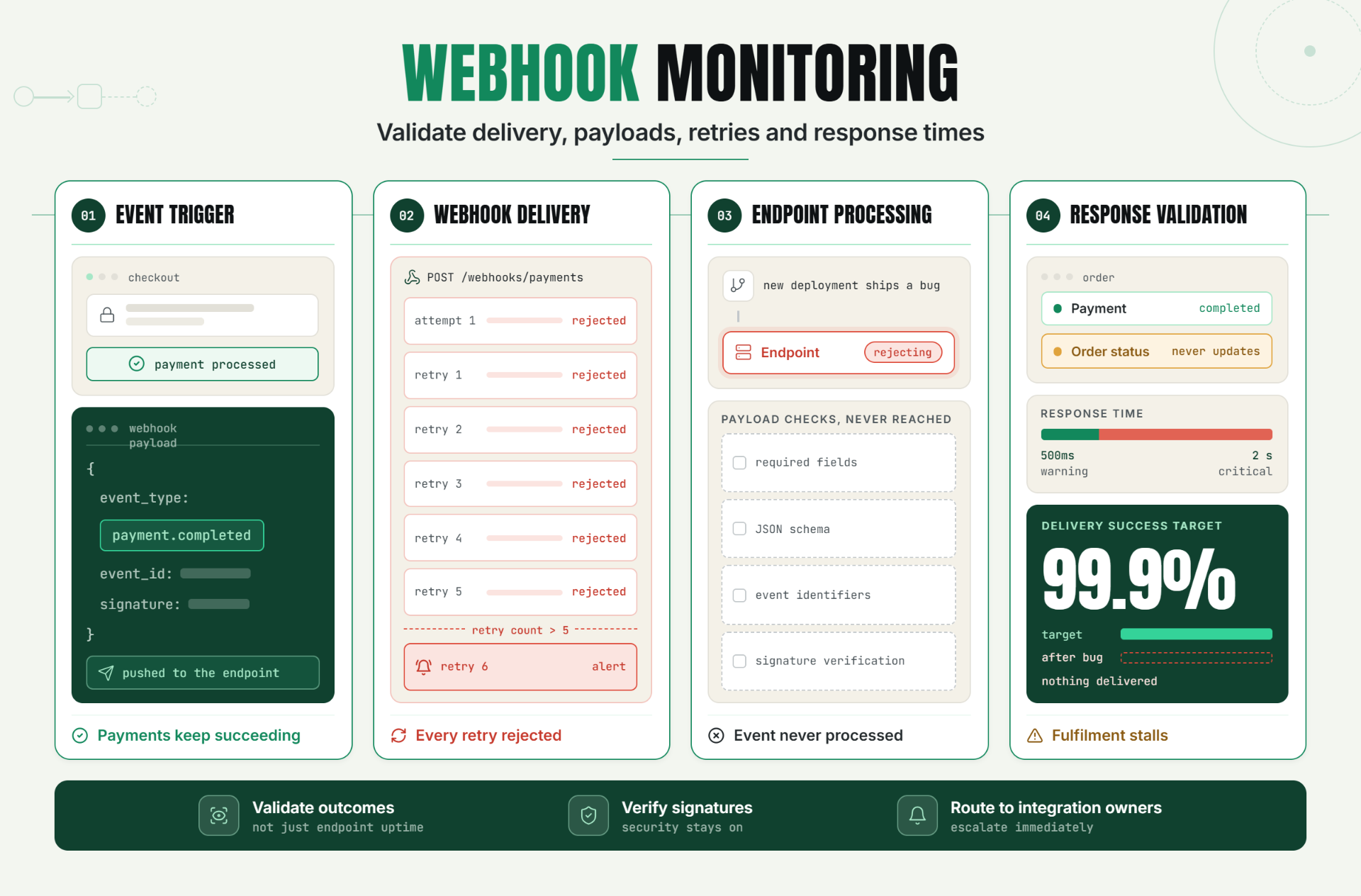
Example flow:Event Trigger > Webhook Delivery > Endpoint Processing > Response ValidationMonitoring should validate every stage of this workflow.
Webhook Delivery Monitoring
Delivery monitoring verifies that webhook requests successfully reach destination endpoints.
Key validations include:
- Endpoint availability.
- Successful delivery.
- HTTP response validation.
- Retry behavior.
- Delivery latency.
Payload Validation
A successful delivery does not guarantee correct processing.
Monitoring should validate:
- Required fields.
- Payload structure.
- JSON schema compliance.
- Event identifiers.
- Signature verification.
event_type: payment.completedWebhook Retry Monitoring
Many platforms retry failed webhook deliveries automatically.
Monitoring retry activity helps identify persistent integration failures.
Example alert condition:Retry Count > 5Response Time Monitoring
Slow webhook processing can cause timeout errors and trigger unnecessary retries.
Monitoring should track:
- Response time.
- Processing latency.
- Queue delays.
- Timeout frequency.
Key Signals to Monitor
| Signal | Purpose |
|---|---|
| Delivery Success Rate | Measure reliability |
| Response Time | Track performance |
| Retry Count | Detect failures |
| Payload Validation | Verify data integrity |
| Endpoint Availability | Detect outages |
| Timeout Rate | Identify slow systems |
Recommended Thresholds
- Warning response time: 500ms
- Critical response time: 2 seconds
- Delivery success target: 99.9%
- Retry alert threshold: More than 5 retries
A Realistic Production Scenario and Recommended Monitor Setup
Scenario: Ecommerce Payment Processing
An ecommerce platform relies on payment webhooks to update order status after successful transactions.
A deployment introduces a bug that causes the webhook endpoint to reject incoming requests.
Payments continue processing successfully, but order statuses never update.
The Business Impact
- Delayed order fulfillment.
- Customer confusion.
- Support ticket increases.
- Revenue reporting inaccuracies.
Recommended Monitor Setup
| Monitor Type | Purpose |
|---|---|
| Webhook Delivery Monitor | Verify event delivery |
| Endpoint Availability Monitor | Validate uptime |
| Payload Validation Monitor | Verify data structure |
| Response Time Monitor | Track performance |
| Retry Monitor | Detect delivery failures |
This layered monitoring approach provides visibility into the entire webhook delivery lifecycle.
Best Practices: Coverage, Check Frequency, Validation, Ownership, and Escalation
1. Monitor Business-Critical Webhooks
Prioritize payment, billing, authentication, and customer-facing workflows.
2. Validate Payload Content
Verify required fields and expected values.
3. Track Retry Activity
Retry spikes often indicate hidden integration issues.
4. Monitor Response Times
Detect performance degradation before timeouts occur.
5. Verify Signature Validation
Ensure webhook security mechanisms remain operational.
6. Define Ownership
Assign responsibility for webhook reliability and incident response.
7. Create Escalation Procedures
Route integration failures to the correct teams immediately.
Common Mistakes: Weak Checks, Noisy Alerts, Missing Dependencies, and Poor Routing
Mistake 1: Monitoring Endpoint Uptime Only
Better approach: Validate actual webhook deliveries and processing outcomes.
Mistake 2: Ignoring Payload Validation
Better approach: Verify data integrity alongside delivery success.
Mistake 3: Missing Retry Monitoring
Better approach: Track retry frequency and failure patterns.
Mistake 4: Not Monitoring Response Times
Better approach: Detect slow processing before it triggers retries.
Mistake 5: Poor Alert Ownership
Better approach: Route alerts directly to integration owners.
Reliable Integrations Depend on Reliable Webhooks
Webhook-driven integrations power many critical business workflows. Even small delivery issues can create operational disruptions, data inconsistencies, and poor customer experiences.
By monitoring delivery success, validating payloads, tracking retries, and measuring response times, teams can identify problems before they affect users and downstream systems.
The first step is identifying business-critical webhook integrations and implementing monitoring that validates the entire delivery lifecycle.
Start Monitoring Webhooks Today
Ready to improve integration reliability?
Start your 30-day Statixoup beta and configure webhook monitors for your critical integrations.
Validate webhook delivery, detect failures faster, and receive alerts before integration issues impact your business.