Trusted Website Monitoring Services from Statixoup
Keeping a website online isn't enough anymore. Uptime, performance, APIs, SSL certificates, and domains all need to work together to keep customers happy. This guide breaks down what a complete website monitoring service should cover, why gaps in any one layer can cost real revenue, and how Statixoup brings uptime, performance, API, SSL, and domain monitoring into a single dashboard.
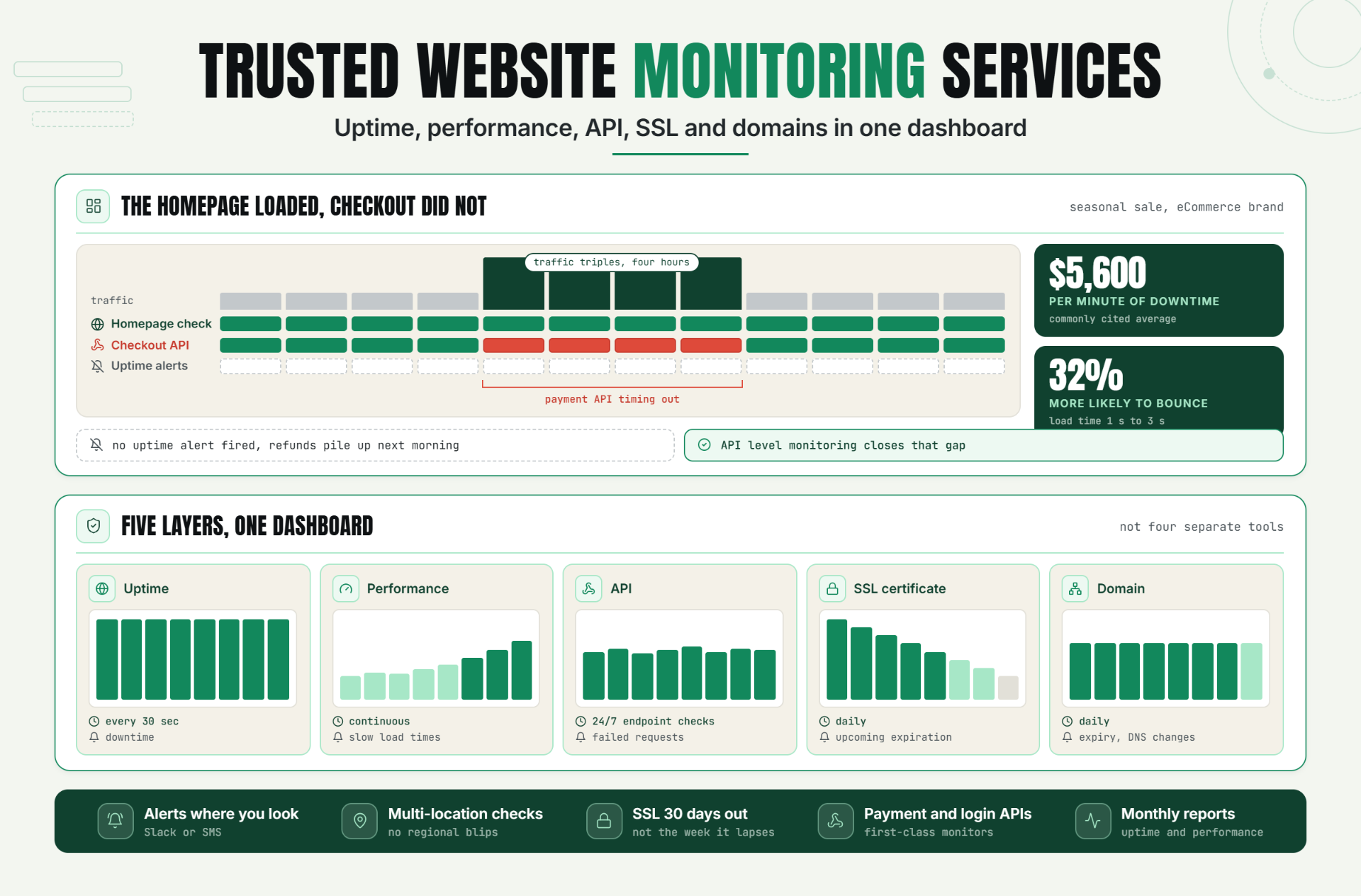
A website monitoring service continuously checks your website, APIs, SSL certificates, domains, and server connectivity, then alerts your team the moment something breaks - so you find out from a notification, not an angry customer. Statixoup is one platform built to do exactly that, combining uptime, performance, API, SSL, and domain monitoring into a single dashboard.
Statixoup is the monitoring platform this guide is built around, and if you're evaluating a website monitoring service for the first time, the rest of this piece walks through what it should actually cover.
The Problem With "Just Checking If It's Up"
Most teams start with a free uptime pinger and figure that's enough. It isn't. Your website depends on a chain of things working at once - the server, the domain's DNS records, the SSL certificate, and any APIs your app calls for payments, logins, or third-party data. A basic ping only tells you the homepage loaded. It says nothing about a payment API timing out, a certificate that expires next Tuesday, or a page that technically "loads" in 11 seconds.
For a SaaS or eCommerce business, that gap is expensive. Customers don't distinguish between "the site is down" and "the site is slow and broken" - they just leave.
What a Complete Website Monitoring Service Should Cover
A real website monitoring service isn't one check, it's five or six working together. At minimum, that means uptime, performance, APIs, SSL, domains, and ideally scheduled jobs like CRON tasks. Statixoup packages all of this into one dashboard, which matters more than it sounds - switching between four different tools during an actual incident wastes the minutes that matter most.
Here's the breakdown of what each piece actually does.
Website Uptime Monitoring
This is the baseline: automated checks at regular intervals (Statixoup runs these as often as every 30 seconds) that confirm your site is reachable and responding correctly, not just returning a response.
What a solid uptime monitoring setup includes:
- 24/7 automated checks so availability is verified around the clock, not just during business hours
- Real-time downtime alerts sent the moment a check fails, not after several failed attempts go unnoticed
- Multi-location checks to confirm your site is reachable from more than one region - a server issue in one data center shouldn't go unnoticed because your monitor only checks from one place
- Historical uptime reports so you can see availability trends over days, weeks, and months, not just the current status
- Fast issue detection that shortens the gap between something breaking and someone knowing about it
When your website goes down, customers can't browse, can't check out, can't log in, and quietly lose trust in the brand. Every minute adds up: the average cost of downtime is commonly cited around $5,600 per minute across industries, and while that figure varies enormously by business size, the direction is the same for everyone - unmonitored downtime is a revenue leak, not just an IT annoyance.
Website Performance Monitoring
Staying online isn't the whole job. A site that loads slowly drives away visitors almost as effectively as one that's fully down. Google's own research on mobile page speed found that the probability of a visitor bouncing increases by 32% as load time goes from one second to three seconds - and it keeps climbing from there.
A proper website performance monitoring layer tracks:
- Website response time
- Page loading performance over time
- Server response speed
- Performance trends across days and weeks
- Historical performance reports for comparison
The point isn't just knowing your site is slow - it's catching the slowdown before a Black Friday spike or a product launch turns it into a full outage.
API Monitoring
If your app processes payments, authenticates users, or pulls in data from a third-party service, it's leaning on APIs, and APIs fail quietly. Your homepage can look completely fine while the checkout API is timing out in the background.
API monitoring should cover:
- 24/7 checks on REST API endpoints
- Verification of response status and availability, not just "the endpoint responded"
- Response time and performance tracking
- Instant detection of API failures
- Real-time alerts the moment something breaks
This matters most for the systems that don't have a visible front end: payment gateways, login and authentication flows, CRM integrations, mobile app backends, and any third-party service your product depends on. When one of these fails silently, it interrupts operations long before anyone notices a pattern in support tickets.
SSL Certificate Monitoring
SSL certificates encrypt the connection between your site and its visitors, and they expire - often without much warning if nobody's watching the calendar. An expired certificate throws a security warning in the browser, and most visitors close the tab the second they see one.
SSL certificate monitoring should track:
- Certificate validity and status
- Expiration dates well ahead of time
- Advance renewal alerts, not last-minute ones
- Reduced risk of unexpected certificate failures
- A consistently secure browsing experience for every visitor
An expired certificate isn't just a technical hiccup - it can dent SEO, spike support requests, and interrupt transactions mid-checkout.
Domain Monitoring
Your domain is one of the most overlooked assets in the whole stack. If it lapses or a DNS record breaks, your website, email, and every connected service can go dark at once.
Domain monitoring covers:
- Domain expiration dates
- Domain status changes
- Renewal reminders sent early enough to act on
- DNS-related change tracking
- General domain health visibility
Losing a domain unexpectedly is one of the more painful outages to recover from, since it can take hours or days to propagate a fix even after you catch the problem.
What I've Seen Go Wrong Without It
Picture a mid-sized eCommerce brand running its own seasonal sale. Traffic triples for four hours, the payment API starts timing out under load, and nobody notices until refund requests start piling up the next morning. No uptime alert fired because the homepage was still loading fine - it was only the checkout API quietly failing. By the time the team traced it back, the sale window had already closed.
That's a realistic pattern I've seen play out across fast-growing SaaS and eCommerce teams, and it's exactly the gap that API-level and multi-layer monitoring is built to close. A homepage that "looks up" tells you almost nothing about whether a customer can actually complete a purchase.
Choosing the Right Monitoring Service: Best Practices
Picking a monitoring service isn't about grabbing the first uptime checker you find. Match the tool to what actually breaks in your stack.
| Monitoring Type | Best For | Check Frequency | Alerts On |
|---|---|---|---|
| Uptime Monitoring | Any live website or app | Every 30 sec - 3 min | Downtime, connection failures |
| Performance Monitoring | Sites with checkout flows or high traffic | Continuous | Slow load times, response lag |
| API Monitoring | SaaS platforms, payment flows, integrations | 24/7 endpoint checks | Failed requests, timeouts |
| SSL Certificate Monitoring | Any HTTPS site | Daily | Upcoming expiration |
| Domain Monitoring | Every business with a registered domain | Daily | Expiration, DNS changes |
A few things worth doing from day one:
- Set alerts to go to a channel your team actually watches (Slack or SMS, not a buried inbox)
- Turn on multi-location checks so a regional network blip doesn't get mistaken for your site being down
- Monitor SSL expiration at least 30 days out, not the week it lapses
- Treat your payment and login APIs as first-class monitors, not an afterthought
- Review historical uptime and performance reports monthly, not just when something breaks
Common Mistakes Teams Make
Relying on a single homepage check. A homepage that loads doesn't mean checkout, login, or your API endpoints are working. Monitor the paths customers actually use.
Setting SSL alerts too close to expiration. A five-day warning isn't enough if the person who handles renewals is out that week. Thirty days gives you a real buffer.
Ignoring performance until it's a complaint. Teams often wait for a slow-site complaint instead of watching response-time trends, by which point visitors have already started bouncing.
Skipping domain monitoring entirely. It's easy to assume auto-renewal will just work. Expired domains and broken DNS records are some of the hardest outages to recover from quickly.
Using four separate tools instead of one platform. Checking uptime in one dashboard, SSL in another, and APIs in a third slows down incident response exactly when speed matters most.
Final Thoughts
The businesses that handle downtime well aren't the ones that never have problems - they're the ones that find out about problems before their customers do. That's the entire value of a website monitoring service: fewer surprises, faster fixes, and a lot less time spent explaining to customers why the site was broken for three hours.
If you're running a SaaS product or an online store and you're still relying on a single uptime ping, that's the gap worth closing first.
Ready to Monitor Everything From One Dashboard?
Statixoup brings uptime, performance, API, SSL, and domain monitoring into a single platform. You can get started for free with monitors, heartbeats, and a status page, compare options on the pricing page as your needs grow, dig into setup details in the documentation, or reach out to the team if you're not sure which plan fits.