DNS Propagation Monitoring: How to Verify Changes Across Global Resolvers
A DNS change that resolves correctly on your laptop can still be wrong for users on the other side of the world for hours. Learn how DNS propagation monitoring tracks changes across global resolvers, and how to avoid mistaking normal delay for a real problem.
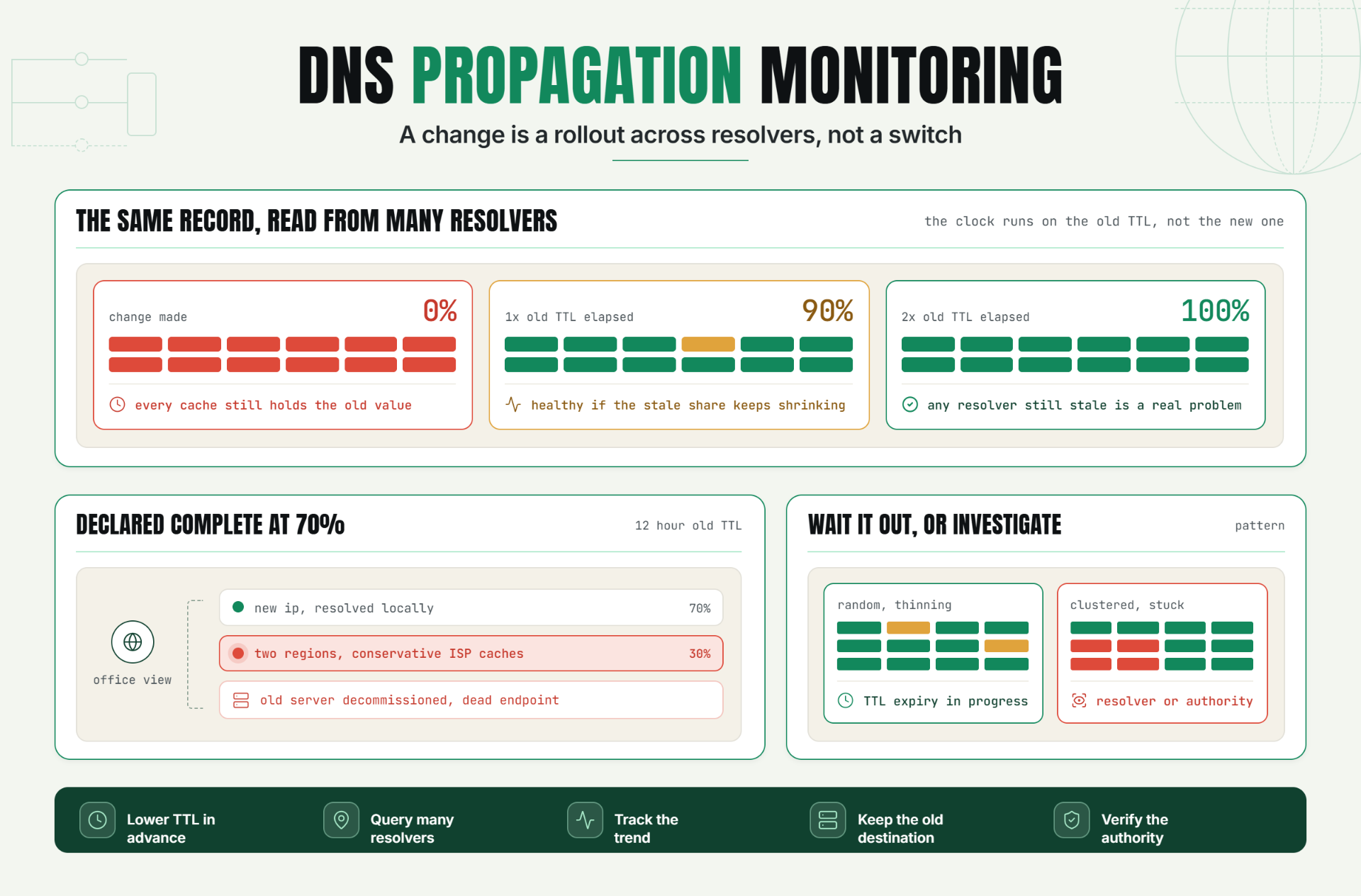
You update an A record at 9:00 a.m. By 9:05, it resolves correctly from your laptop. By 9:20, a customer in another country is still landing on the old server. Nobody made a second change. Nothing is actually broken.
That's a propagation gap, not a DNS failure. DNS propagation monitoring exists precisely because a DNS change isn't a single event it's a gradual, uneven rollout across thousands of independent resolvers, each caching your records on its own schedule. Treating it like an instant switch is where most migration incidents actually start.
Why DNS Propagation Monitoring Matters to Reliability and Customer Experience
DNS records are cached, not fetched fresh on every request. Each resolver an ISP's DNS server, a public resolver, a corporate network's internal DNS stores a record for as long as its TTL (Time to Live) value says it's valid, and refreshes it only after that window expires. That's by design: RFC 1035, the original DNS specification, built caching in specifically to reduce load on authoritative servers. It's also exactly why a DNS change doesn't reach everyone at once.
Global DNS check tooling exists because your own view of a change is not representative. Your laptop's resolver might refresh in seconds. A customer three networks and one continent away might still be looking at a cached record for hours, especially if a previous TTL was set high and hasn't fully expired.
This matters operationally because a migration, a CDN switch, or a nameserver change all depend on this same invisible clock. Without visibility into how a change is actually propagating, teams either declare success too early while a meaningful share of users are still hitting the old destination or panic over a delay that's completely normal and just hasn't finished yet.
The Operational Risk of Assuming DNS Changes Are Instant
Most DNS related incidents during a migration aren't caused by a wrong record. They're caused by an accurate record that hasn't reached everyone yet, combined with a team that assumed it had.
A few structural realities make this risk worse than it looks:
- TTL is a ceiling, not a guarantee. A record with a 24 hour TTL set before a migration can keep serving stale answers to some resolvers for up to that long, regardless of how quickly the authoritative record was updated.
- Resolvers behave inconsistently. Public resolvers like Google Public DNS and Cloudflare's 1.1.1.1 generally respect TTL closely, but ISP level and corporate resolvers vary some cache longer than specified, some refresh sooner. There's no single "propagation time" that applies everywhere.
- A single-location check hides the real picture. Confirming a record change from one machine, in one region, on one network, says nothing about the other networks your actual users sit behind.
- Rollbacks compound the problem. If a team reverts a change because it looks broken from their vantage point, that reintroduces a second wave of propagation delay layered on top of the first often making the actual user facing inconsistency last longer, not shorter.
Without resolver monitoring across a representative set of global resolvers, teams typically find out propagation is incomplete the same way they find out about most invisible failures: a support ticket from a user in a region nobody checked, or a monitoring alert that looks like a fresh outage but is actually leftover cache behavior from a change made hours earlier.
How DNS Propagation Monitoring Works: Key Signals, Thresholds, and Diagnosis
What "Propagation" Actually Means
Propagation isn't a push nothing broadcasts your DNS change to the internet. It's the natural result of caches expiring and re querying the authoritative nameserver. DNS propagation monitoring works by repeatedly querying the same record from many resolvers in parallel, comparing the answers, and tracking how the split between old and new values changes over time.
Key Signals to Track
- Consistency ratio what percentage of checked resolvers currently return the new value versus the old one.
- Geographic and network spread whether inconsistency is clustered in specific regions or ISPs, or scattered randomly (scattered usually means simple TTL expiry in progress; clustered can indicate a resolver specific caching issue or an unreachable authoritative server from that region).
- Time since change was made propagation status is meaningless without knowing how long the clock has been running relative to the previous TTL.
- Authoritative nameserver response confirming the source of truth itself is correct and consistent, separate from what any individual resolver currently has cached.
DNS Propagation Time: What to Actually Expect
DNS propagation time depends almost entirely on the TTL that was set before the change, not the TTL set after it. If a record carried a 24 hour TTL going into a migration, some resolvers can legitimately serve the old value for up to 24 hours after the authoritative record changes even though the new TTL might now be five minutes. This is why lowering TTL well in advance of a planned change is standard migration practice, not an afterthought.
Setting Thresholds for Propagation Checks
| Signal | Healthy Pattern | Investigate When |
|---|---|---|
| Consistency ratio at 1x old TTL elapsed | > 90% resolvers on new value | < 90% and still climbing slowly |
| Consistency ratio at 2x old TTL elapsed | ~100% resolvers on new value | Any resolver still on old value |
| Authoritative nameserver answer | Matches intended record immediately | Any mismatch or timeout |
| Geographic clustering of stale answers | None, or random/thinning over time | Persistent clustering in one region/ISP |
These aren't hard alert thresholds in the same sense as an uptime check propagation is expected to be incomplete early on. The signal worth watching is the trend: is the stale percentage shrinking as expected relative to the old TTL, or is it stuck?
Diagnosis: Distinguishing Propagation Delay From an Actual Problem
When a DNS record update doesn't seem to be taking effect everywhere, the diagnostic question is: has enough time passed relative to the previous TTL, and if so, is the remaining inconsistency random or clustered?
- Random, thinning inconsistency well within the old TTL window normal propagation in progress.
- Consistency stuck below 100% well past the old TTL window points to a resolver caching longer than it should, or an authoritative nameserver returning inconsistent answers itself.
- Clustered inconsistency in one specific region or network points to a local resolver issue, or the authoritative server being unreachable from that specific network path, which is where DNS troubleshooting shifts from "wait it out" to actual investigation.
A Practical Production Scenario
Consider an illustrative example.
A company migrates its main application to a new hosting provider and updates its A record accordingly. The previous record had a 12 hour TTL, set months earlier and never revisited. The team checks the new IP from their office network immediately after the change, sees it resolving correctly, and announces the migration as complete.
Four hours later, support tickets start arriving from users in two specific regions still being served the old, now decommissioned server, which is throwing connection errors as its services get wound down.
The team runs a check across a broader set of global resolvers and finds the issue immediately: consistency sits at roughly 70%, with the remaining stale answers concentrated in ISPs known to cache more conservatively than their stated TTL. Because the old server is being decommissioned rather than left running as a safety net, those users are hitting a dead endpoint instead of simply seeing slightly outdated (but functional) service.
The fix isn't a new DNS change it's patience plus mitigation: keep the old server reachable until the previous TTL window fully elapses, and recheck propagation status at intervals until the stale percentage reaches zero.
Recommended Monitor Setup
- Lower TTL on any record well in advance of a planned migration, giving the old TTL time to fully expire before the change happens.
- Check propagation from a broad, geographically distributed set of resolvers, not just one local machine.
- Track the consistency ratio over time relative to the old TTL, rather than expecting an instant 100%.
- Keep the old destination reachable until propagation is confirmed complete, rather than decommissioning it immediately.
- Separately verify the authoritative nameserver's answer, so a resolver side caching issue isn't mistaken for a source of truth error.
- Recheck at defined intervals (not just once) until consistency reaches the expected threshold.
Best Practices for Monitoring DNS Propagation
Lower TTL Before You Change Anything, Not After
The TTL that governs how long a change takes to propagate is the old one. Reducing it days in advance of a planned migration is the single highest leverage step for a faster, more predictable rollout.
Check From Many Resolvers, Not One
A single machine's DNS cache tells you nothing about the rest of the internet. Use a global DNS check across multiple regions and resolver types to get a representative picture of where propagation actually stands.
Track the Trend, Not a Single Snapshot
One check at 70% consistency doesn't tell you if you're 10 minutes or 10 hours from done. Re check at intervals and watch whether the stale percentage is shrinking at a rate consistent with the old TTL.
Keep Old Infrastructure Alive During the Transition
Don't decommission the previous destination the moment a change looks correct from your own vantage point. Keep it running until propagation is confirmed complete elsewhere, so lagging resolvers still get a working response instead of an error.
Verify the Authoritative Source Separately
Before troubleshooting resolver level caching, confirm the authoritative nameserver itself is answering correctly and consistently. A source of truth problem looks identical to a caching delay until you check it directly.
Document Every Planned Change With Its Timing
Note the exact time a change was made and what the previous TTL was. This turns "is this propagation or a problem?" from a guess into a quick calculation.
Common Mistakes in DNS Propagation Monitoring
Mistake 1: Checking From Only One Location and Declaring Success
Why it happens: the change looks correct from the machine making it, which feels like confirmation.
What to do instead: check from a distributed set of global resolvers before treating a migration as complete.
Mistake 2: Forgetting to Lower TTL Before the Change
Why it happens: TTL is often set once at initial setup and never revisited before a migration.
What to do instead: lower TTL well in advance of any planned DNS change, so the old caching window has already expired by the time the change happens.
Mistake 3: Decommissioning Old Infrastructure Too Early
Why it happens: once the new destination resolves correctly for the team, it's tempting to shut down the old one immediately.
What to do instead: keep the previous destination reachable until propagation is confirmed complete across a broad resolver set.
Mistake 4: Treating Normal Propagation Delay as an Outage
Why it happens: inconsistent results across different networks can look alarming without context on expected timing.
What to do instead: calculate expected propagation time from the previous TTL before assuming something is actually broken.
Mistake 5: Not Separating Resolver Caching From Authoritative Server Issues
Why it happens: both look like "the DNS change isn't working" from the outside.
What to do instead: verify the authoritative nameserver's answer directly and separately from resolver level checks, so you know which layer actually needs fixing.
Mistake 6: Checking Once Instead of Tracking Over Time
Why it happens: a single check feels like enough information to move on.
What to do instead: recheck at defined intervals until the consistency ratio reaches the expected level, since propagation is a process, not a moment.
Start Verifying Your DNS Changes Globally
A DNS change that looks correct from one machine isn't confirmed it's just unverified everywhere else. Real confidence in a migration or DNS record update comes from checking how it's actually resolving across the networks your users are on, not just your own.
Start a 7 day Statixoup trial and configure DNS monitoring across global resolvers to track propagation the next time you make a change. The next migration you run, you'll know exactly where things stand instead of guessing.