Fintech Monitoring: Protect Logins, Payments and APIs
Learn how fintech monitoring helps protect critical customer journeys, including logins, payments, APIs, certificates, and third-party dependencies. This guide explains how meaningful checks, effective alert routing, and reliable incident records improve fintech availability and support compliance evidence.
A customer enters the right password, completes strong authentication, and still can't reach the account screen. The homepage is green. The login service isn't. That gap is exactly why fintech monitoring must follow real user journeys, not just ping a public URL.
Statixoup is a website and service monitoring platform for teams that need early outage signals. In a fintech environment, the job is to watch customer-facing availability across login, payments, APIs, certificates, and dependencies, then retain a useful timeline for incident review. It doesn't replace fraud controls, security monitoring, or a compliance program. It gives operations teams a clear external view of whether critical workflows are working.
The short answer is simple: fintech monitoring checks whether high-impact financial journeys complete correctly, from the user's location and at the required speed. Strong coverage combines availability, response time, content validation, certificate checks, API assertions, dependency checks, and accountable alert routing.
The real risk behind a green homepage
Fintech failures rarely respect neat system boundaries. A login can fail because an identity provider is slow. A card authorization can time out while the marketing site loads instantly. A balance endpoint can return stale data with a successful HTTP status. A third-party bank API can degrade in one region only.
That creates two problems. Customers see a financial service they can't trust, while the operations team receives weak evidence about what broke and when. Payment uptime is therefore more than server availability. It includes successful completion, correct responses, acceptable latency, regional reachability, and a timestamped incident trail.
My view is blunt: a monitor that only asks, "Did the server answer?" is too weak for money movement. It can be useful as a base layer, but it shouldn't be the signal that wakes the payment team.
How fintech monitoring works
Fintech monitoring is the repeated testing of critical financial application paths from outside the production stack. Each check asks a narrow question, records the result, and triggers a defined response when the answer falls outside an agreed threshold.
Start with customer-visible workflows
Build coverage from impact, not architecture diagrams. Begin with the workflows that create immediate customer harm when they fail:
- Sign-in and strong customer authentication
- Account or wallet dashboard loading
- Beneficiary or payee validation
- Payment initiation and authorization
- Transaction status lookup
- Webhook receipt and acknowledgement
- Refund, payout, or settlement status
- Public status communication
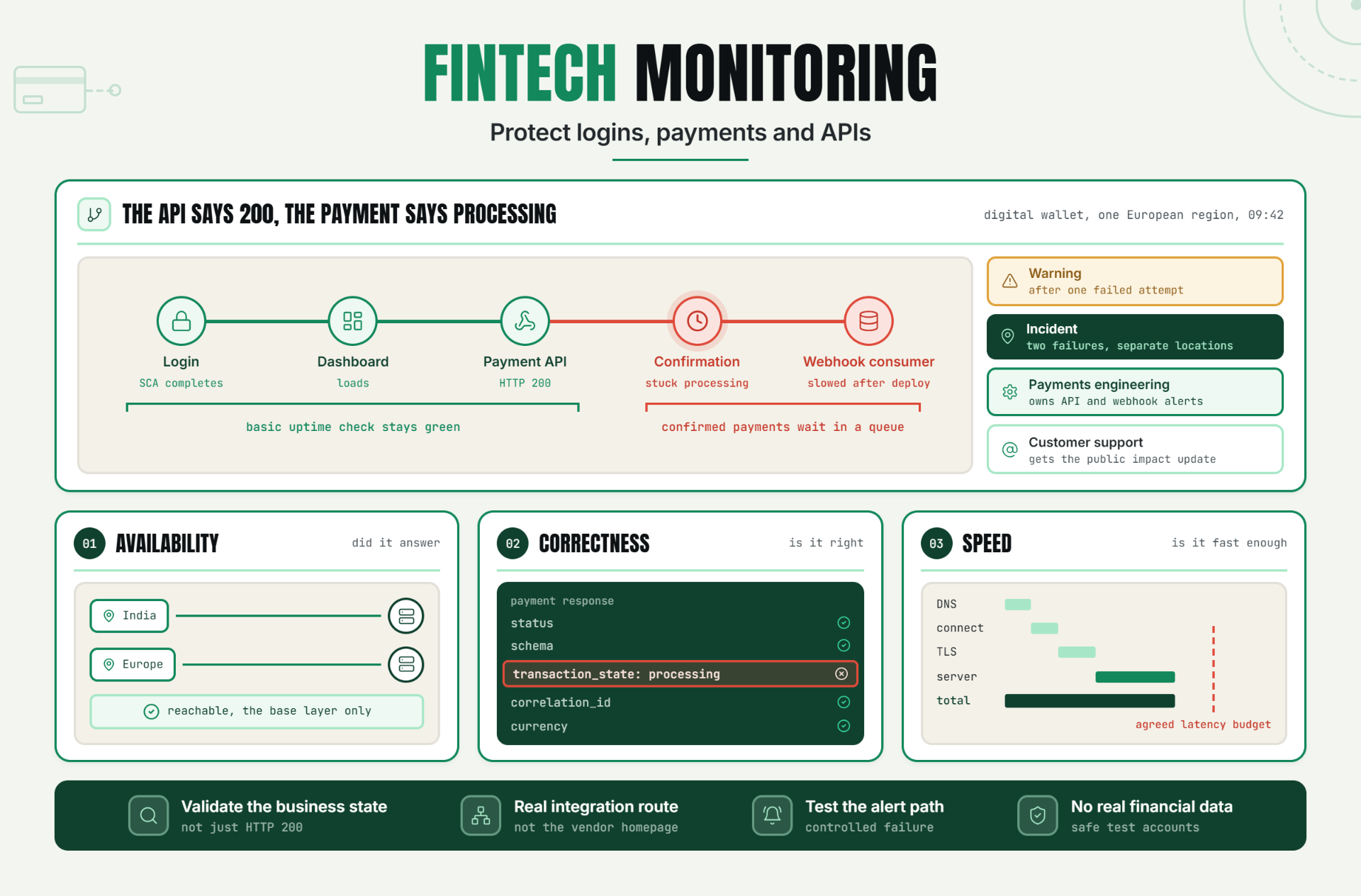
For each workflow, define success in business terms. A login isn't successful because `/login` returned 200. It succeeds when the form loads, the authentication handoff completes, the expected account page appears, and the total journey stays inside the agreed latency budget.
Separate availability, correctness, and speed
Good financial API monitoring tests three different conditions. Availability asks whether the endpoint responds. Correctness checks status codes, required fields, schemas, signatures, or expected text. Speed measures DNS, connection, TLS, server response, and total duration.
Don't collapse these into one alert. If an API responds in 9 seconds with the wrong currency field, it is technically reachable and operationally broken.
What to validate in a payment response
Use a safe test environment or a non-financial production probe approved by your security and compliance owners. Validate the HTTP status, response schema, transaction-state field, unique correlation ID, expected currency, and maximum response time. Never place real cardholder data, credentials, or secrets in a public monitor configuration.
The OWASP API Security Top 10 for 2023 lists ten major API risk categories, including broken authentication, unrestricted resource consumption, improper inventory management, and unsafe consumption of APIs. That isn't a monitoring checklist by itself. It is a reminder that API reachability and API security are different jobs, and both need owners.
Monitor dependencies without losing ownership
Most payment journeys cross systems your team doesn't fully control: identity providers, card processors, open-banking providers, DNS, certificate authorities, cloud regions, SMS gateways, and email providers. Dependency monitoring should answer two questions: is the provider reachable, and is your integration with it still working?
This distinction matters. A provider status page can be green while your account, region, certificate chain, IP allowlist, or API version is failing. Run a direct check against the exact integration path where policy allows it.
For a starting point, review Statixoup's monitoring platform and map each customer workflow to one external check. Then add dependency probes only where they shorten diagnosis.
Turn checks into an evidence trail
Audit evidence isn't a screenshot taken the night before an assessment. Useful evidence shows the monitor definition, check frequency, timestamps, results, alert delivery, acknowledgement, escalation, and incident closure.
NIST SP 800-137 describes continuous monitoring as a way to maintain visibility into assets, threats, vulnerabilities, and the effectiveness of security controls. The NIST continuous monitoring guidance focuses on timely risk awareness. External availability data can support that picture, but it doesn't prove that every security or regulatory control is effective.
PCI DSS v4.0.1 is equally important to scope correctly. Its official PCI SSC document library is the source to use for current standard text. Website monitoring can support operational records, but a green uptime report doesn't prove PCI DSS compliance.
Configure fintech monitoring step by step
- List the five customer journeys that would create the most harm if they failed.
- Break each journey into endpoints and dependencies.
- Define a safe success assertion and latency threshold.
- Choose check locations and frequency.
- Route warnings and incidents to named owners.
- Test the alert path.
- Retain results with deployment and incident timestamps.
The result is coverage that supports both response and review.
Use the resulting map as a tight coverage checklist. Fintech monitoring for login should validate the completed authentication path. Fintech monitoring for payments should verify the expected business state. Fintech monitoring for APIs should inspect fields and latency. Fintech monitoring for certificates should warn before expiry. Fintech monitoring for dependencies should use the real integration route. Fintech monitoring for webhooks should confirm acknowledgement. Fintech monitoring for regions should match customer locations. Fintech monitoring for evidence should retain timestamps and ownership. Fintech monitoring for alerts should be tested through escalation. Fintech monitoring for status communication should reflect customer-visible impact.
A realistic production scenario
Consider an illustrative digital wallet operating in India and Europe. At 09:42, customers in one European region can log in but payment confirmation pages remain stuck on "processing." The payment API returns 200, so the basic uptime check stays green.
What didn't work? The team monitored the API endpoint but didn't validate the transaction-state field. A downstream webhook consumer had slowed after a deployment, leaving confirmed payments waiting in an internal queue.
The improved setup uses four checks: a one-minute login journey, a one-minute API assertion against a safe synthetic transaction status, a webhook acknowledgement check, and a five-minute regional dashboard check. A warning triggers after one failed attempt. An incident triggers after two failures from separate locations. Payments engineering owns the API and webhook alerts; customer support receives the public-impact update.
The result in this example isn't a made-up percentage improvement. It is better diagnosis: the alert identifies the broken stage, the timeline shows the first failure, and the deployment marker gives responders a useful lead.
The European Central Bank and European Banking Authority reported that payment fraud in the European Economic Area reached EUR 4.2 billion in 2024, up from EUR 3.5 billion in 2023. They also found card-payment fraud was 17 times higher when the recipient was outside the EEA, where strong customer authentication often wasn't used. Those figures don't mean uptime tools stop fraud. They show why financial workflows need layered controls and reliable operational visibility. See the joint ECB and EBA payment fraud report.
Teams evaluating this setup can use the Statixoup website monitoring service as a place to begin defining endpoint and journey coverage.
Best practices for fintech reliability
Tie every check to impact and an owner
Write the owner beside the monitor before enabling the alert. A payment authorization failure should reach the team that can act, while support gets the customer-facing impact. Ownership cuts the "whose service is this?" delay.
Use short intervals for high-impact paths
Check critical login, payment, and API paths every minute when the plan and risk model allow it. Use longer intervals for lower-impact pages. The point isn't maximum check volume. It is detection speed that matches business harm.
Require meaningful validation
Assert the expected field, state, or page element. Follow redirects. Detect expired certificates. Set latency thresholds from observed normal performance, then review them after architecture or traffic changes.
Test the alert, not just the monitor
Run a controlled failure test. Confirm delivery, acknowledgement, escalation, status-page workflow, and after-hours routing. If nobody receives the alert during a test, the monitoring system didn't pass.
Protect evidence and secrets
Restrict configuration access, mask secrets, use dedicated low-privilege accounts, and keep an approved retention schedule. Exported audit evidence should show what happened without exposing customer or cardholder data.
You can explore Statixoup for external availability checks while keeping SIEM, fraud analytics, application telemetry, and compliance evidence repositories in their proper roles.
Common fintech monitoring mistakes
Treating HTTP 200 as success
Why it happens: simple checks are fast to configure. What to do instead: validate the response body, business state, redirect destination, and timing.
Sending every alert to everyone
Why it happens: broad routing feels safe. It creates noise and weak ownership. Route by service and severity, then give support a separate customer-impact channel.
Ignoring regional and third-party failure
A single check location can miss DNS, routing, CDN, or provider issues. Use locations that reflect the customer base and test the integration path, not just a vendor homepage.
Putting real financial data in synthetic checks
Never use live card numbers or customer credentials just to make a monitor realistic. Agree on safe test accounts, tokens, data, and cleanup with security and compliance teams.
Calling uptime data "compliance proof"
Availability history is one evidence source. It doesn't replace access logs, control testing, risk assessment, incident records, or assessor judgment. Keep the claim narrow and defensible.
Before rollout, use Statixoup's monitoring overview to list supported check types, then confirm each planned assertion, retention need, and notification path with the product team.
Conclusion
The best fintech monitoring setup doesn't monitor everything. It monitors the few workflows where failure damages trust quickly, validates the real outcome, and tells the right person what broke.
Start with one payment journey. Follow it from authentication to confirmation, write down the success conditions, and test the alert path. That single exercise will expose more useful gaps than another generic dashboard.
Start a 30-day Statixoup beta
Start a 30-day Statixoup beta and configure the first monitor around a real customer workflow, such as login, payment authorization, or transaction status. Define the expected result, choose a check interval, assign the alert owner, and run a controlled failure test before calling the setup complete.
Start a 30-day Statixoup betaEditor note: No author name or role was supplied or verifiable on the accessible public sources. Add the approved Statixoup author bio, photo, role, and professional profile before publishing.
Post a Comment

Hardik Vaghani
Hardik Vaghani is a Digital Marketing Professional and SEO Strategist based in Surat, Gujarat, India. He currently works with Ethnic Infotech, contributing to SEO, content marketing, technical SEO, and digital growth strategies. Hardik also creates blog content for Fusion5, focusing on technology, laptops, and consumer electronics. With expertise in SEO, Google Ads, Meta Ads, Local SEO, and Content Strategy, he helps businesses improve online visibility, rankings, and lead generation through data-driven marketing.
Frequently Asked Questions
Related Blogs