Best Website Monitoring Solutions by Statixoup (2026)
Downtime doesn't hit every business the same way. This guide walks through how 15 industries, from eCommerce and SaaS to healthcare, finance, and government, each rely on website monitoring in different ways, and how Statixoup's uptime, API, SSL, and domain monitoring adapts to fit whatever matters most to your business.
A hospital's patient portal going down for twenty minutes is not the same problem as an online store's checkout button failing for twenty minutes but both cost real money, real trust, and in one case, potentially real patient safety. That's the thing most generic monitoring advice misses: the risk of downtime looks completely different depending on what your business actually does. If you're evaluating website monitoring solutions and trying to figure out whether a platform actually fits your industry, that's exactly what this guide breaks down.
Fast answer: The right website monitoring solution depends on what's actually at stake in your industry lost sales for eCommerce, churned subscriptions for SaaS, compliance and patient safety for healthcare, or public trust for government services. Statixoup covers uptime, performance, API, SSL, and domain monitoring in one dashboard, which is flexible enough to serve all of these use cases from a single platform.
Why Monitoring Needs Differ by Industry
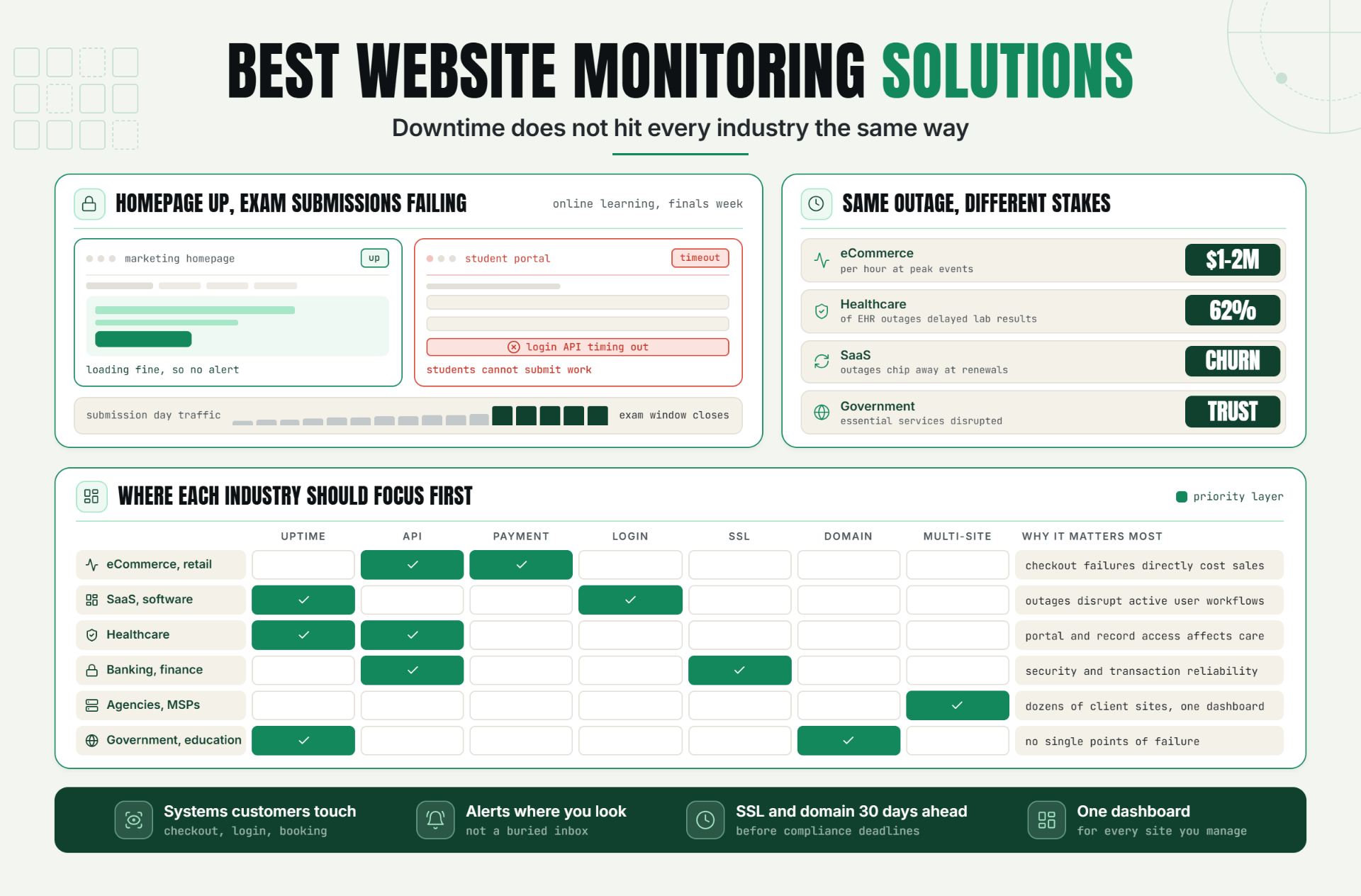
Downtime doesn't hit every business the same way. A five-minute outage on an eCommerce checkout page during a flash sale is a direct revenue loss you can calculate in real time. The same five minutes on a hospital's patient portal can delay lab results and disrupt care. Research on hospital systems found that lab test results were delayed in roughly 62% of cases during unexpected electronic health record outages - a statistic that has nothing to do with revenue and everything to do with patient safety.
That's why a one-size-fits-all uptime checker rarely covers what a business actually needs. A website monitoring solution has to flex around the systems that matter most to your operations - whether that's a payment gateway, a login portal, a booking engine, or a citizen services form.
15 Industries That Rely on Website Monitoring Solutions
Here's how the need for a monitoring platform plays out across different sectors, and what each one tends to care about most.
1. eCommerce Businesses
Every visitor to an online store is a potential order, and every failed checkout is a lost one. If a website goes offline during a sale, or the payment step breaks, customers don't wait around they leave and often don't come back.
Statixoup helps online stores stay available by continuously monitoring website uptime, page performance, SSL certificates, APIs, and payment-related services, with instant alerts so a team can respond before more customers are affected. Whether the store runs on Shopify, WooCommerce, Magento, or a custom platform, the monitoring layer works the same way underneath.
2. SaaS Companies
SaaS businesses live and die by uninterrupted access. Even a short outage disrupts customers mid-workflow, spikes support tickets, and chips away at renewal confidence.
Statixoup continuously monitors SaaS websites, APIs, login portals, and application performance, helping teams catch issues before users notice them. For a SaaS company, uptime isn't a technical metric on a dashboard somewhere - it's directly tied to customer satisfaction and retention.
3. Digital Marketing Agencies
Agencies juggle dozens of client sites, each with different hosts, domains, and monitoring needs, which makes manual checking impossible to keep up with.
Statixoup gives agencies a centralized dashboard to monitor every client website from one place, with instant notifications when a site experiences downtime, SSL issues, or performance problems. That proactive visibility is what lets an agency catch a client's issue before the client does.
4. IT Companies & Managed Service Providers (MSPs)
MSPs are responsible for infrastructure reliability across multiple clients and environments at once, which is a lot of surface area to watch manually.
Statixoup simplifies that by continuously monitoring websites, APIs, domains, servers, network ports, and SSL certificates from one platform, cutting down the manual checking that eats into an IT team's day. With one dashboard covering multiple systems, technicians spend more time fixing problems than hunting for them.
5. Educational Institutions
Schools, colleges, and online learning platforms depend on digital services for admissions, learning management systems, and student communication and downtime during exams or enrollment windows creates real disruption.
Statixoup helps educational institutions monitor website availability, portal performance, and SSL certificates, so students and educators can reliably reach the platforms they need, when they need them.
6. Healthcare Organizations
Healthcare providers run appointments, patient records, and telemedicine through digital platforms, and downtime here can delay patient care, not just inconvenience a user.
Statixoup helps hospitals and clinics monitor websites, patient portals, APIs, and SSL certificates around the clock, giving IT teams the real-time alerts they need to resolve issues before they affect patients or staff.
7. Banking & Financial Services
Banks and fintech companies operate where reliability and security aren't optional - customers expect 24/7 access to online banking and payment services.
Statixoup continuously monitors banking websites, APIs, SSL certificates, and domains, helping technical teams catch issues before they reach customers. In financial services, proactive monitoring is as much about maintaining trust as it is about uptime numbers.
8. Travel & Hospitality Businesses
Hotels, airlines, and booking platforms depend on their websites to manage reservations and process payments. A booking system going down means lost reservations, full stop.
Statixoup helps travel and hospitality businesses monitor uptime, booking systems, APIs, and performance, so travelers can book with confidence and issues get resolved before they turn into lost revenue.
9. Logistics & Supply Chain Companies
Shipment tracking, warehouse management, and inventory systems all run on digital platforms, and even a short interruption can delay operations and frustrate customers waiting on updates.
Statixoup monitors websites, APIs, and tracking systems to help logistics companies catch problems early, keeping supply chain operations running and shipment updates accurate.
10. Manufacturing Companies
Manufacturers increasingly run production schedules, supplier portals, and enterprise applications through digital systems, where downtime translates directly into delayed operations.
Statixoup provides continuous monitoring for business websites, internal applications, APIs, and domains, helping manufacturers catch issues before they become costly disruptions on the production floor.
11. Government Organizations
Public service portals handle tax filing, citizen applications, and utility payments services that thousands of people may need on any given day. Downtime here isn't just inconvenient, it disrupts essential services.
Statixoup helps government organizations monitor website availability, SSL certificates, APIs, and domains around the clock, so IT teams can resolve issues quickly and keep public services accessible.
12. Media & News Websites
News sites and digital media platforms need continuous availability, especially during high-traffic events when the risk of slow performance or downtime spikes right when readership is highest.
Statixoup continuously monitors website uptime, page performance, and APIs to help media organizations stay fast and available for readers, protecting both audience trust and advertising revenue during traffic surges.
13. Real Estate Businesses
Real estate websites showcase listings, generate leads, and connect buyers with agents. If the site goes down or a contact form breaks, that's a lead that never reaches anyone.
Statixoup helps real estate businesses monitor uptime, lead generation pages, APIs, and domain health, so buyers can always reach property information and agencies don't quietly lose inquiries.
14. Corporate Businesses
Corporate websites are often the first stop for customers, partners, investors, and job seekers, and many organizations also lean on employee portals and HR systems for daily operations.
Statixoup provides comprehensive monitoring for corporate websites, business applications, APIs, and domains, helping organizations catch issues before they affect employees or customers and protect brand reputation in the process.
15. Startups & Growing Businesses
For a startup, every visitor and lead matters more than it might for an established company downtime during a product launch or marketing push can set momentum back significantly.
Statixoup gives startups an affordable, scalable monitoring solution that covers website availability, APIs, SSL certificates, and domains from a single dashboard, growing alongside the business without adding complexity.
What Actually Happens When Monitoring Is Missing
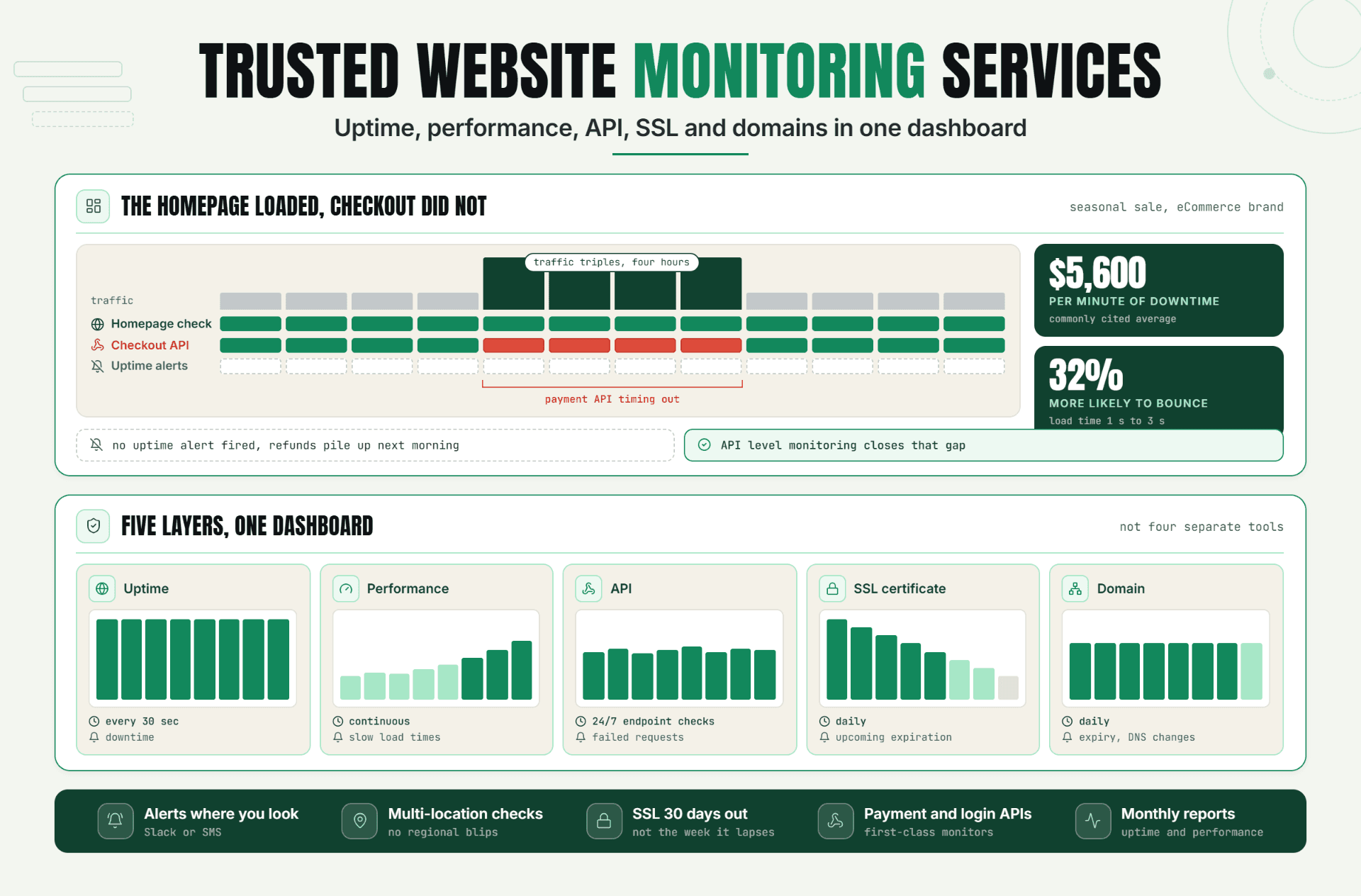
Take a mid-sized online learning platform running final exams for the week. Traffic spikes hard on submission day, the student portal's login API starts timing out under load, and nobody notices because the marketing homepage is still loading fine. By the time support tickets start flooding in from students who couldn't submit their work, the exam window has already closed for a chunk of them.
That's a realistic pattern across industries that assume "the site is up" means "everything is working." A homepage that loads tells you almost nothing about whether the systems your users actually depend on - checkout, login, booking, patient portals - are functioning underneath it.
The financial side of this varies a lot by industry. Outage-cost research shows e-commerce platforms can lose $1-2 million per hour during peak events like Black Friday, while finance and healthcare outages can run even higher once regulatory exposure and compliance penalties are factored in. The exact number changes by sector, but the underlying lesson doesn't: the businesses that catch problems fastest lose the least.
Choosing a Website Monitoring Solution: Best Practices
Different industries should weigh different monitoring layers more heavily. Here's a rough guide to where to focus first:
| Industry Type | Priority Monitoring Layer | Why It Matters Most |
|---|---|---|
| eCommerce & Retail | API + Payment monitoring | Checkout failures directly cost sales |
| SaaS & Software | Uptime + Login portal monitoring | Outages disrupt active user workflows |
| Healthcare | Uptime + API monitoring | Patient portal and record access affects care |
| Banking & Finance | SSL + API monitoring | Security and transaction reliability are non-negotiable |
| Agencies & MSPs | Centralized multi-site monitoring | Dozens of client sites need one dashboard, not many |
| Government & Education | Uptime + Domain monitoring | Public service access can't have single points of failure |
A few habits worth adopting regardless of industry:
- Prioritize the systems customers actually interact with (checkout, login, booking), not just the homepage
- Route alerts to a channel your team checks constantly, not an inbox that gets buried
- Set SSL and domain renewal alerts at least 30 days ahead, especially for regulated industries with compliance deadlines
- Review historical uptime and performance reports on a schedule, not just after an incident
- If you manage multiple sites (agency, MSP, franchise), consolidate monitoring into one dashboard instead of juggling several tools
Common Mistakes Businesses Make
Assuming one monitoring setup fits every part of the business. A homepage check tells you nothing about whether your booking system, patient portal, or payment API is actually working.
Treating monitoring as an IT-only concern. Downtime affects sales, patient care, public trust, or client relationships depending on the industry - it's a business risk, not just a technical one.
Waiting for compliance requirements to force the decision. Healthcare, finance, and government organizations often only add proper monitoring after an incident triggers a compliance review, instead of getting ahead of it.
Ignoring domain and SSL expiration until it's urgent. This is an easy one to overlook, and it's just as damaging in a hospital system or bank as it is on a small business site.
Running separate tools per client or department. Agencies and MSPs especially fall into this trap, checking five dashboards instead of one, which slows down response time exactly when speed matters.
Final Thoughts
Every industry on this list is dealing with the same underlying problem in a different costume: digital reliability directly affects the people who depend on the business, whether that's a customer checking out, a patient accessing records, or a citizen filing paperwork. The businesses that handle this well aren't the ones with zero downtime - they're the ones that catch it fast enough that most users never notice.
If you're weighing website monitoring solutions and unsure which layers matter most for your industry, start with whatever system your customers actually touch first - checkout, login, or booking - and build outward from there.
Keep Every Part of Your Business Online
Statixoup brings together website uptime monitoring, performance monitoring, API monitoring, SSL certificate monitoring, domain monitoring, port monitoring, ping monitoring, and keyword monitoring in one centralized platform, built to flex across industries rather than force a single generic setup. You can get started for free with monitors and a status page, compare plans as your needs grow on the pricing page, check setup details in the documentation, or talk to the team about what fits your industry best.
Post a Comment

Hardik Vaghani
Hardik Vaghani is a Digital Marketing Professional and SEO Strategist based in Surat, Gujarat, India. He currently works with Ethnic Infotech, contributing to SEO, content marketing, technical SEO, and digital growth strategies. Hardik also creates blog content for Fusion5, focusing on technology, laptops, and consumer electronics. With expertise in SEO, Google Ads, Meta Ads, Local SEO, and Content Strategy, he helps businesses improve online visibility, rankings, and lead generation through data-driven marketing.
Frequently Asked Questions
Related Blogs