Healthcare Website Monitoring for Patient Portal Access
Learn how healthcare website monitoring protects patient access across portals, logins, APIs, appointments, SSL, and browser journeys. This guide explains how to detect failures quickly while using synthetic data and privacy-safe monitoring practices.
Statixoup monitors websites, APIs, SSL certificates, DNS, ports, and browser journeys from one platform, with checks as often as every 30 seconds and validation designed to reduce false alarms. For a healthcare portal, the useful goal is simple: detect when patients cannot complete an important, permitted action while keeping protected health information out of the monitoring process.
In plain language, healthcare website monitoring checks whether public and authenticated digital services are reachable, responsive, and behaving as expected. A sound setup tests the service in layers, uses synthetic data rather than real patient records, limits captured content, and routes confirmed incidents to an accountable team. It supports reliability work; it does not by itself make a system HIPAA compliant.
The stakes are no longer niche. The U.S. Office of the Assistant Secretary for Technology Policy reported that 65% of individuals were offered and accessed an online medical record or patient portal in 2024, up from 25% in 2014. Portal availability is now part of ordinary patient access, not an optional digital extra.
The Operational Risk Behind a “Healthy” Portal
Healthcare teams rarely lose sleep over a homepage alone. Healthcare website monitoring has to reflect the patient who cannot sign in, the caregiver who cannot retrieve instructions, the referral form that silently drops a submission, or the appointment workflow that fails after an identity-provider change.
Without layered healthcare website monitoring, these failures surface through call-center complaints, front-desk escalation, or a vendor ticket. By then, the incident has already become a patient-access problem. A basic HTTP 200 check can miss a broken login button, an API returning stale data, an expired certificate on a subdomain, or a page that loads but never becomes usable.
Privacy adds a second constraint. The monitor needs enough evidence to diagnose failure, but it should not collect names, dates of birth, diagnoses, messages, or screenshots containing real patient information. Reliability evidence is useful. Uncontrolled evidence collection is a liability.
How Healthcare Website Monitoring Works
Good healthcare website monitoring is layered. Each layer answers a different question, and no single check can replace the others.
Start with availability, then test function
In healthcare website monitoring, an uptime check asks whether an endpoint responds. It should cover the public portal, login entry point, appointment front end, status page, and other patient-facing domains. Record status code, latency, TLS validity, redirect behavior, and response content that proves the expected application answered.
That last point matters. A load balancer can return a friendly error page with HTTP 200. Content validation catches that false green by looking for a stable, non-sensitive marker such as “Sign in” or a known application shell element.
Browser checks then test what an actual user must do. For example, load the portal, accept required consent, enter a dedicated synthetic account, complete MFA in a test-safe way if supported, and verify that a neutral dashboard element appears. Statixoup describes browser monitoring with Playwright and full JavaScript rendering, which is the right class of check for modern portals whose critical behavior happens after the initial HTML response.
Use a synthetic identity, never a patient identity
Create a monitored test tenant or account containing fabricated information and no link to a real person. Give it the minimum permissions needed for the journey. If a workflow cannot be tested without real electronic protected health information, stop and redesign the check with the privacy, security, and application owners.
The HHS HIPAA Security Rule requires appropriate administrative, physical, and technical safeguards for the confidentiality, integrity, and availability of electronic protected health information. That means healthcare website monitoring should be designed inside the organization’s risk-management process, not treated as a shortcut around it.
Add healthcare API monitoring for hidden dependencies
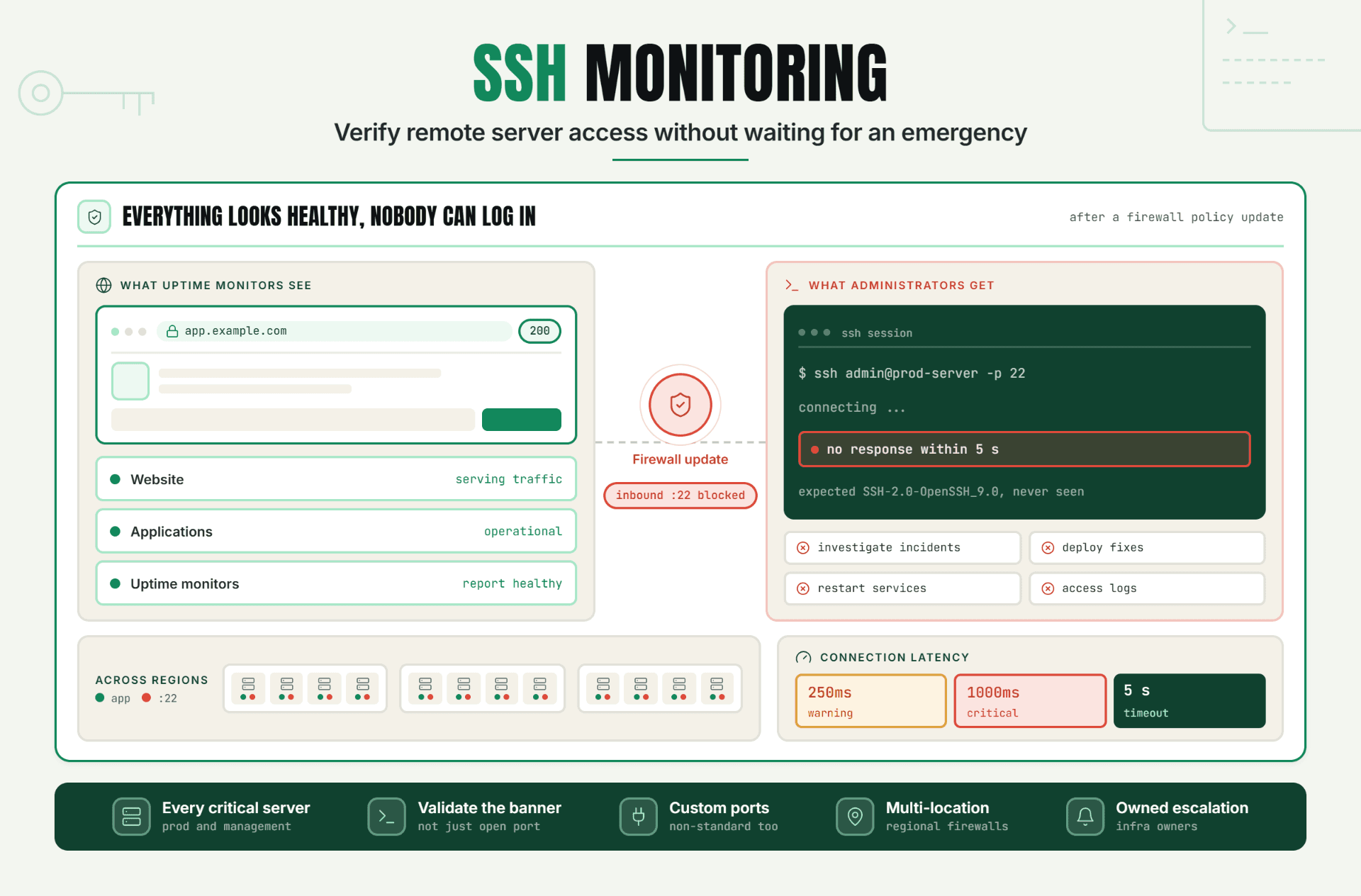
A portal can render while its dependencies fail. That is why healthcare website monitoring must include healthcare API monitoring for the services behind authentication, appointments, results, messaging, payments, and notifications where those checks are authorized.
For each endpoint, validate more than reachability:
- Expected status code and a safe response schema
- Response time against a service-specific baseline
- Authentication behavior using a scoped synthetic credential
- Correct handling of a deliberately invalid request
- Certificate validity and DNS resolution
- Absence of sensitive payload data in saved logs
Do not send real medical record numbers or patient data simply to make a synthetic check “realistic.” Test the contract, not the person. For event-driven dependencies, Statixoup’s guide to webhook delivery monitoring is a useful companion because a successful API response does not prove that a downstream callback arrived or was processed.
Measure appointment system availability end to end
In healthcare website monitoring, appointment system availability is best measured as a transaction, not a page view. A browser monitor can select a test location, choose a non-production appointment slot, advance to the confirmation boundary, and verify that the workflow remains functional without creating a real booking.
Use the following sequence:
1. Map the patient journey and its dependencies.
2. Create synthetic accounts and safe test data.
3. Add fast uptime and API checks.
4. Add a browser transaction for the highest-value path.
5. Validate failures from a second location.
6. route confirmed alerts to the service owner.
The result is a monitor set that finds both infrastructure outages and user-visible failures.
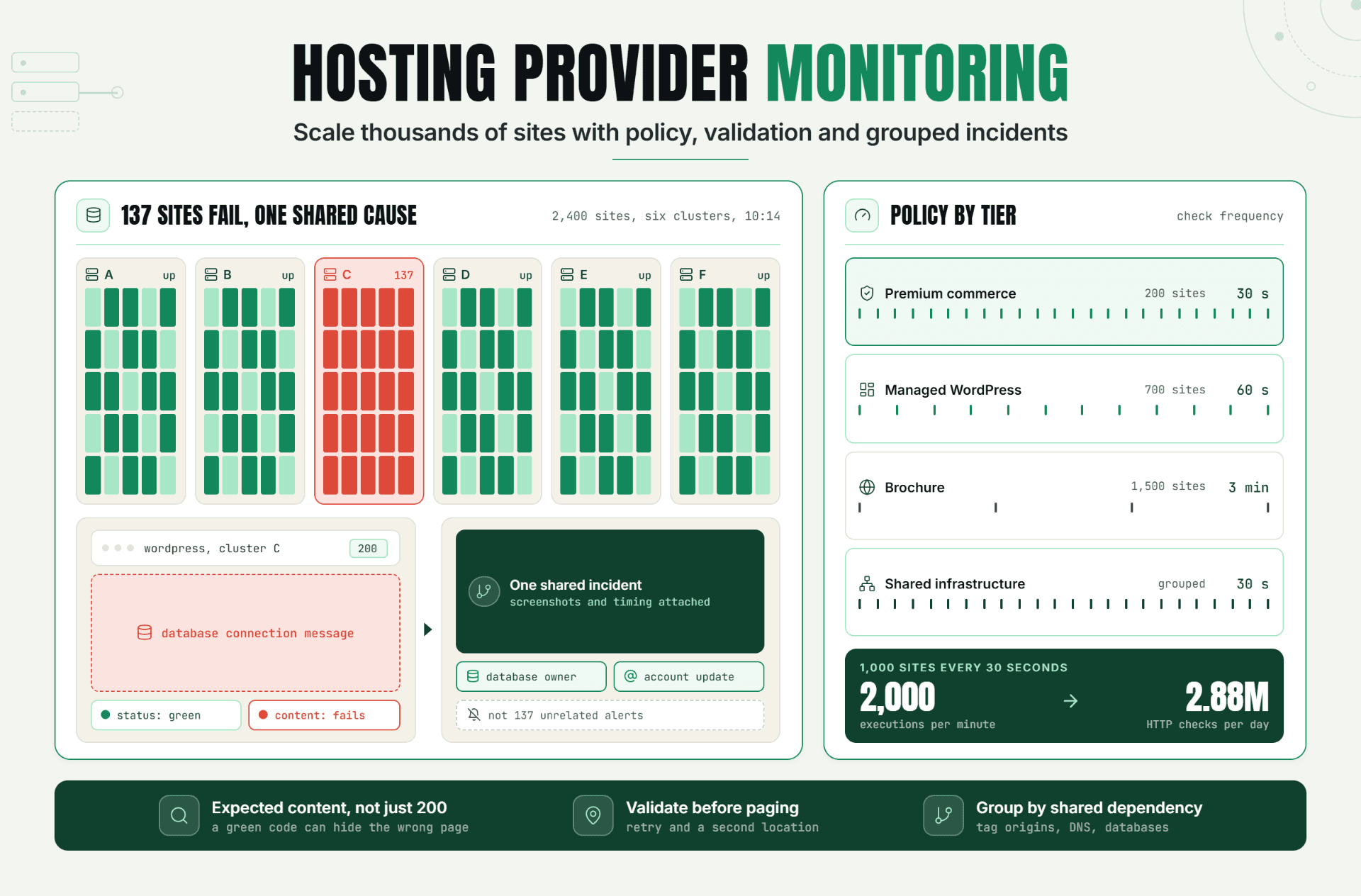
Thresholds should come from observed performance and clinical or operational impact. A practical starting point is a 30- to 60-second check for critical public endpoints, a few minutes for lower-risk functions, and immediate escalation only after confirmation. The number is not sacred. A slow but successful results page may require a different alert policy than a completely unavailable sign-in endpoint.
Build privacy-safe monitoring into evidence collection
Healthcare website monitoring can capture screenshots, response bodies, request headers, query strings, cookies, and traces, all of which may contain sensitive information. Privacy-safe monitoring begins by minimizing what the monitor touches and retains.
Use allowlisted fields, masked secrets, synthetic records, short retention, role-based access, and audit logs. Disable screenshots on pages where sensitive content could appear, or constrain the journey so it stops before that content. Review whether the monitoring provider receives, stores, or transmits ePHI and involve legal and privacy teams in determining contractual requirements, including whether a business associate agreement is necessary.
This distinction is important: a vendor saying “secure” is not the same as the customer completing a HIPAA risk analysis. The HHS Security Rule overview frames confidentiality, integrity, and availability as linked safeguards. Monitoring contributes most directly to availability and integrity signals, but its own data flow must still protect confidentiality.
Separate patient communication from the operator dashboard
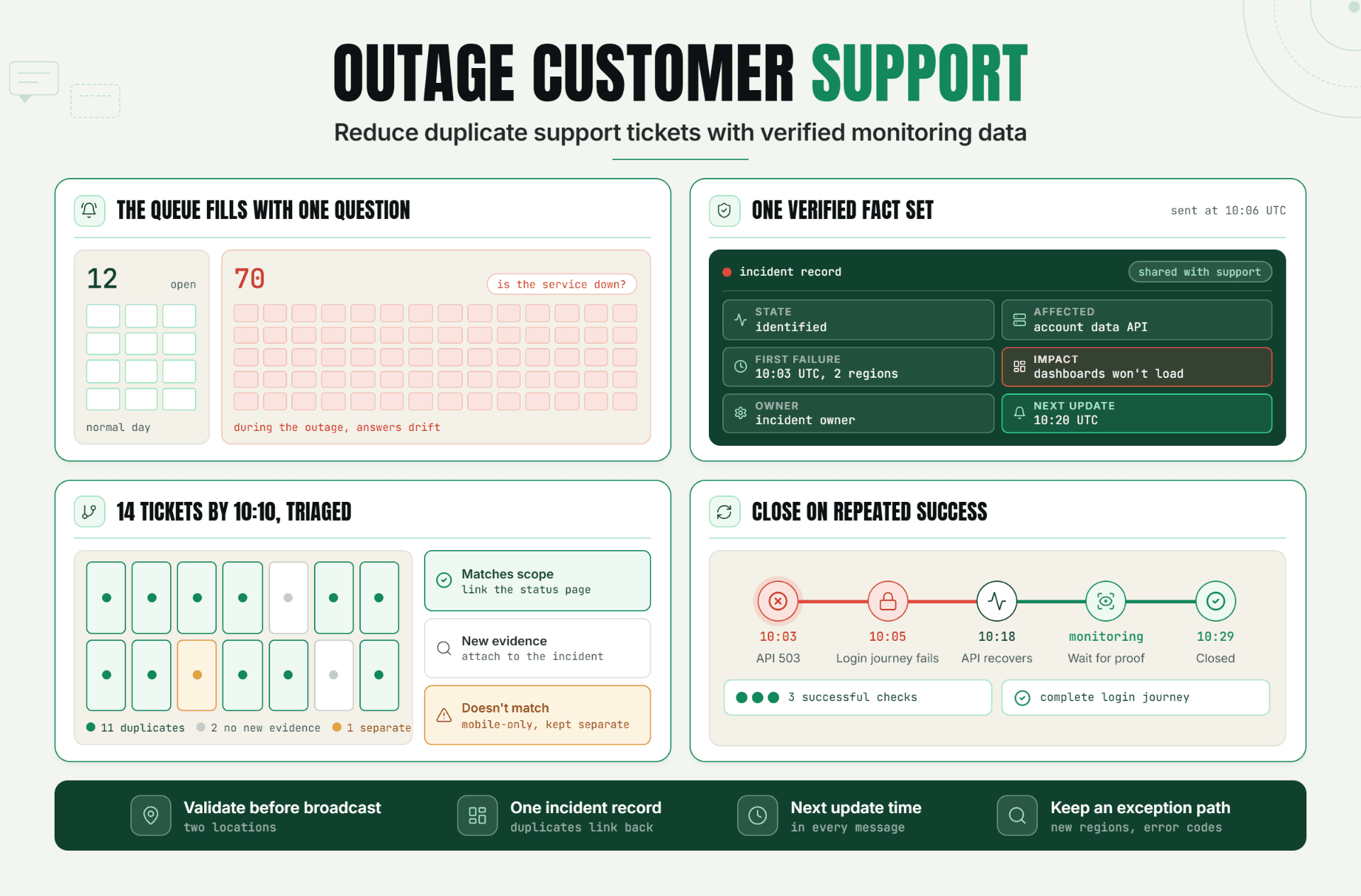
Operators need traces, response codes, dependency details, and escalation history. Patients need a clear statement of what is affected, what still works, and when the next update will appear. Those are different audiences.
A healthcare status page should use service-level labels such as “Patient Portal,” “Appointment Booking,” and “Secure Messaging.” Avoid incident text that reveals patient information, internal hostnames, exploitable details, or speculative causes. Statixoup’s site describes shareable, branded status pages, and its main monitoring overview explains the relationship between monitors, incident evidence, and customer-facing status communication.
An Illustrative Patient-Portal Monitor Plan
Consider a fictional regional clinic network with a patient portal, a third-party identity provider, an appointment API, and a lab-results service. This is an illustrative pattern, not a Statixoup customer claim.
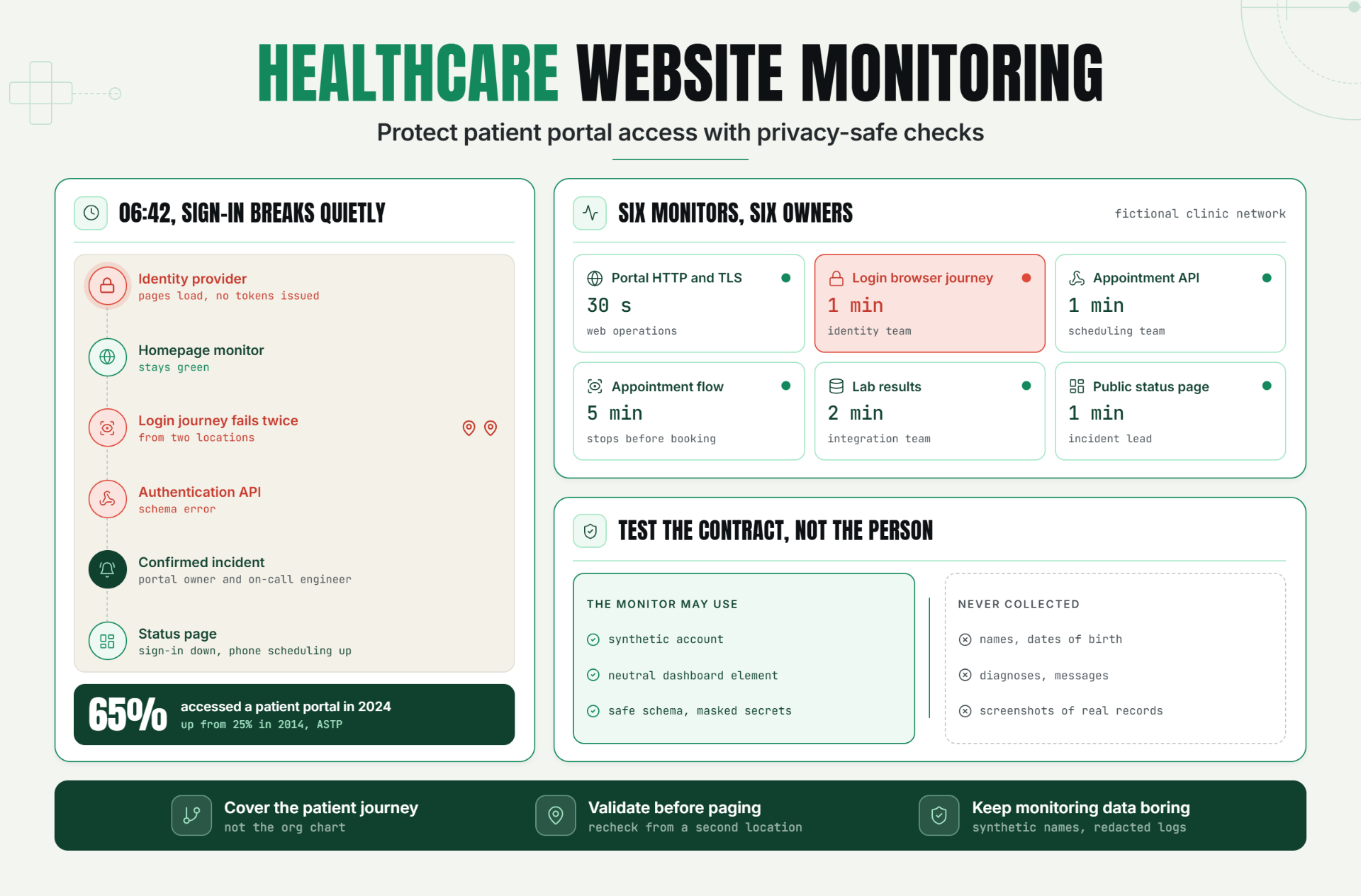
At 06:42, the identity provider begins returning successful pages but fails to issue tokens. The homepage monitor stays green. The synthetic login journey fails twice from two locations, while the authentication API check shows a schema error. A confirmed incident goes to the portal owner and on-call engineer. The public status page reports that portal sign-in is unavailable while phone scheduling remains available.
The recommended setup looks like this:
| Monitor | Frequency | Safe validation | Owner |
|---|---|---|---|
| Portal HTTP and TLS | 30 seconds | Status, certificate, expected public text | Web operations |
| Login browser journey | 1 minute | Synthetic account reaches neutral dashboard | Identity team |
| Appointment API | 1 minute | Safe schema and latency; no patient payload | Scheduling team |
| Appointment browser flow | 5 minutes | Stops before final booking | Digital product |
| Lab-results dependency | 2 minutes | Synthetic empty record or health endpoint | Integration team |
| Public status page | 1 minute | Page reachable from external location | Incident lead |
This healthcare website monitoring design gives the incident lead enough evidence to distinguish application failure from DNS, TLS, identity, or API trouble. It also sets a hard boundary: no real patient record is opened, submitted, or captured.
The patient-access context is worth remembering. ASTP/ONC found that app-based access to online medical records rose from 38% in 2020 to 57% in 2024. A failure may affect mobile API users even when the desktop portal appears fine, so healthcare API monitoring deserves first-class coverage.
For alert delivery, use the channels already owned by the responding team. Statixoup provides documented integrations for Slack uptime alerts and Discord uptime alerts. In a healthcare environment, confirm that alert content itself contains no ePHI before sending it into any collaboration tool.
Best Practices for Reliable, Privacy-Safe Checks
Cover the patient journey, not the org chart
Map sign-in, appointment booking, results access, secure messaging, payments, and password recovery from the patient’s point of view. Assign each journey one owner, even when five vendors support it. Shared ownership too often becomes no ownership during an incident.
Validate before paging
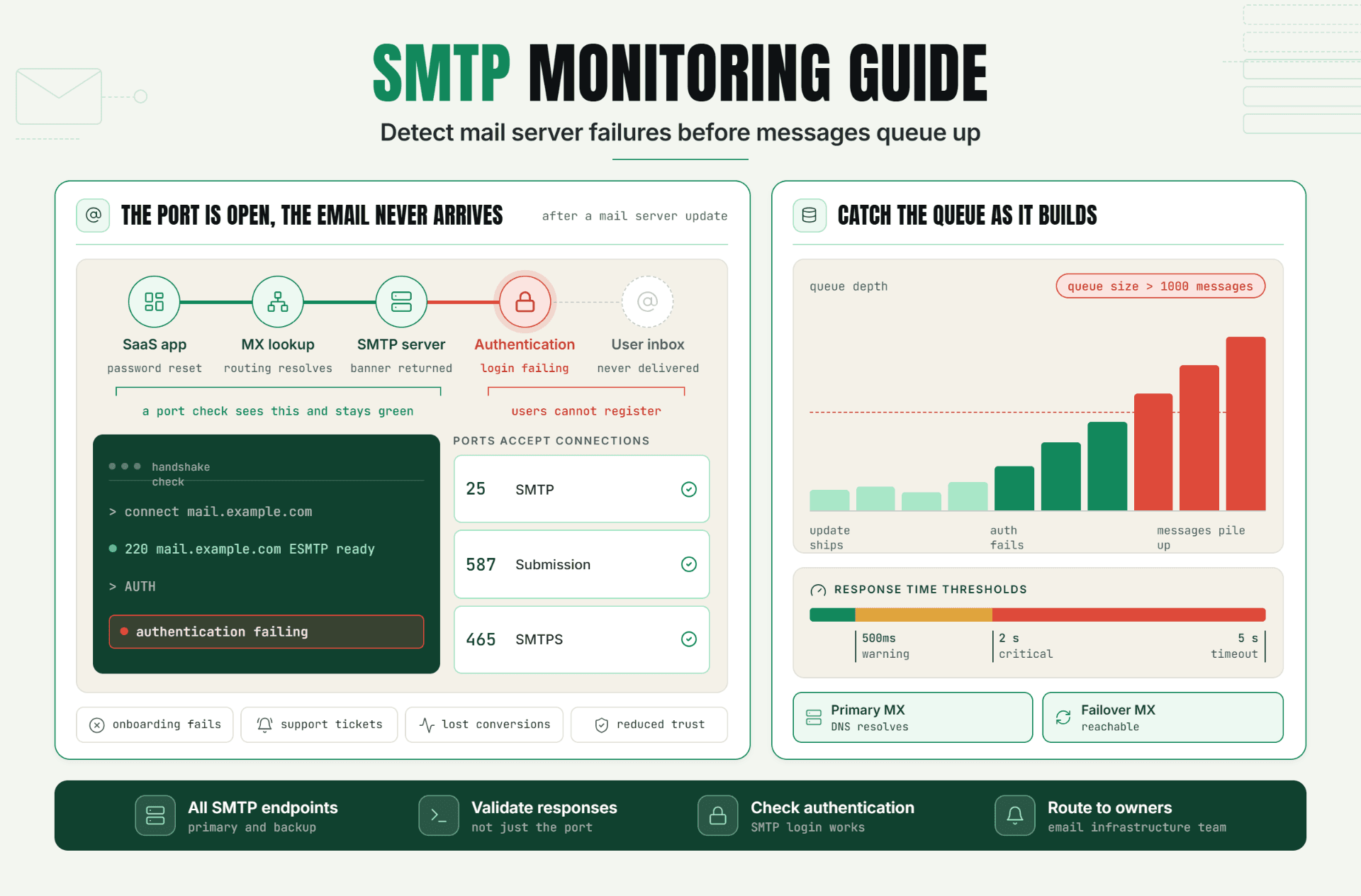
Recheck from a second location or with an independent probe before waking a responder. Statixoup says it validates failures before creating incidents or triggering notifications. That approach matters in healthcare website monitoring because alert fatigue makes the next genuine outage easier to miss.
Keep monitoring data deliberately boring
Synthetic names, empty records, predictable test responses, and redacted logs are features, not limitations. Review saved screenshots and response samples during setup. If an engineer can see patient information in a monitor record, the collection boundary is already too broad.
Set separate warning and incident thresholds
Latency degradation should create a warning before it creates a page. Functional failure, certificate expiry, or authentication failure may need faster escalation. Tune thresholds with real baselines, maintenance windows, and patient impact rather than copying a generic number from another service.
Rehearse status communication
Write approved templates for “investigating,” “identified,” “monitoring,” and “resolved.” Keep them factual and patient-centered. The HHS healthcare cybersecurity performance goals identify incident planning and preparedness as an essential goal, reinforcing that response should be prepared before the outage.
Review the monitor after every material change
Identity-provider migrations, EHR upgrades, API version changes, certificate rotation, and consent-banner changes can break a monitor or the real journey. Treat healthcare website monitoring as production code: version it, test it, assign review dates, and remove stale synthetic credentials.
Common Monitoring Mistakes
Mistake 1: Calling a ping check “patient portal uptime”
Why it happens: ping is simple and cheap. Why it fails: it proves that a host answered, not that a patient can sign in. Add content, API, and browser validation for critical journeys.
Mistake 2: Capturing real patient information for troubleshooting
Why it happens: screenshots and bodies make diagnosis easier. What to do instead: use synthetic records, stop journeys before sensitive views, mask secrets, and restrict evidence retention and access.
Mistake 3: Monitoring only the portal vendor
Why it happens: the portal has a visible URL and contract owner. The real service also depends on DNS, TLS, identity, EHR interfaces, APIs, notification systems, and sometimes payment services. Monitor the dependencies that can independently block patient access.
Mistake 4: Sending every slowdown to the same channel
Why it happens: one route feels easier to administer. It creates noisy alerts and unclear ownership. Route sign-in incidents to identity, appointment failures to scheduling, and broad outages to the incident lead, with timed escalation when acknowledgement is missing.
Mistake 5: Treating a monitoring product as a compliance certificate
Healthcare website monitoring can provide evidence, detection, and availability insight. It cannot replace risk analysis, access control, vendor assessment, incident response, or legal review. Make the monitor part of the control environment, not a claim that the environment is automatically compliant.
Conclusion
Reliable patient access is not captured by one uptime percentage. The useful question is whether a patient or caregiver can complete the next important action safely and on time.
A mature healthcare website monitoring plan combines fast endpoint checks, safe API validation, focused browser journeys, dependency coverage, confirmed alerts, clear ownership, and privacy-controlled evidence. Start with one critical journey, map every dependency behind it, and decide exactly what the monitor may collect before switching it on.
Start a 30-Day Statixoup Beta
Use Statixoup’s 30-day beta program to configure your first healthcare website monitoring checks for a public portal endpoint, API, SSL certificate, or synthetic browser journey. Begin with synthetic data and involve your privacy and security owners before testing any authenticated workflow.
If you need help mapping checks or alert ownership, use Statixoup support. Pricing and plan details are available on the Statixoup pricing page.
Post a Comment

Hardik Vaghani
Hardik Vaghani is a Digital Marketing Professional and SEO Strategist based in Surat, Gujarat, India. He currently works with Ethnic Infotech, contributing to SEO, content marketing, technical SEO, and digital growth strategies. Hardik also creates blog content for Fusion5, focusing on technology, laptops, and consumer electronics. With expertise in SEO, Google Ads, Meta Ads, Local SEO, and Content Strategy, he helps businesses improve online visibility, rankings, and lead generation through data-driven marketing.
Frequently Asked Questions
Related Blogs