SaaS Uptime Monitoring: Detect Downtime Before Customers
SaaS uptime monitoring detects application downtime early, helping teams respond faster, reduce customer impact, and protect renewals.
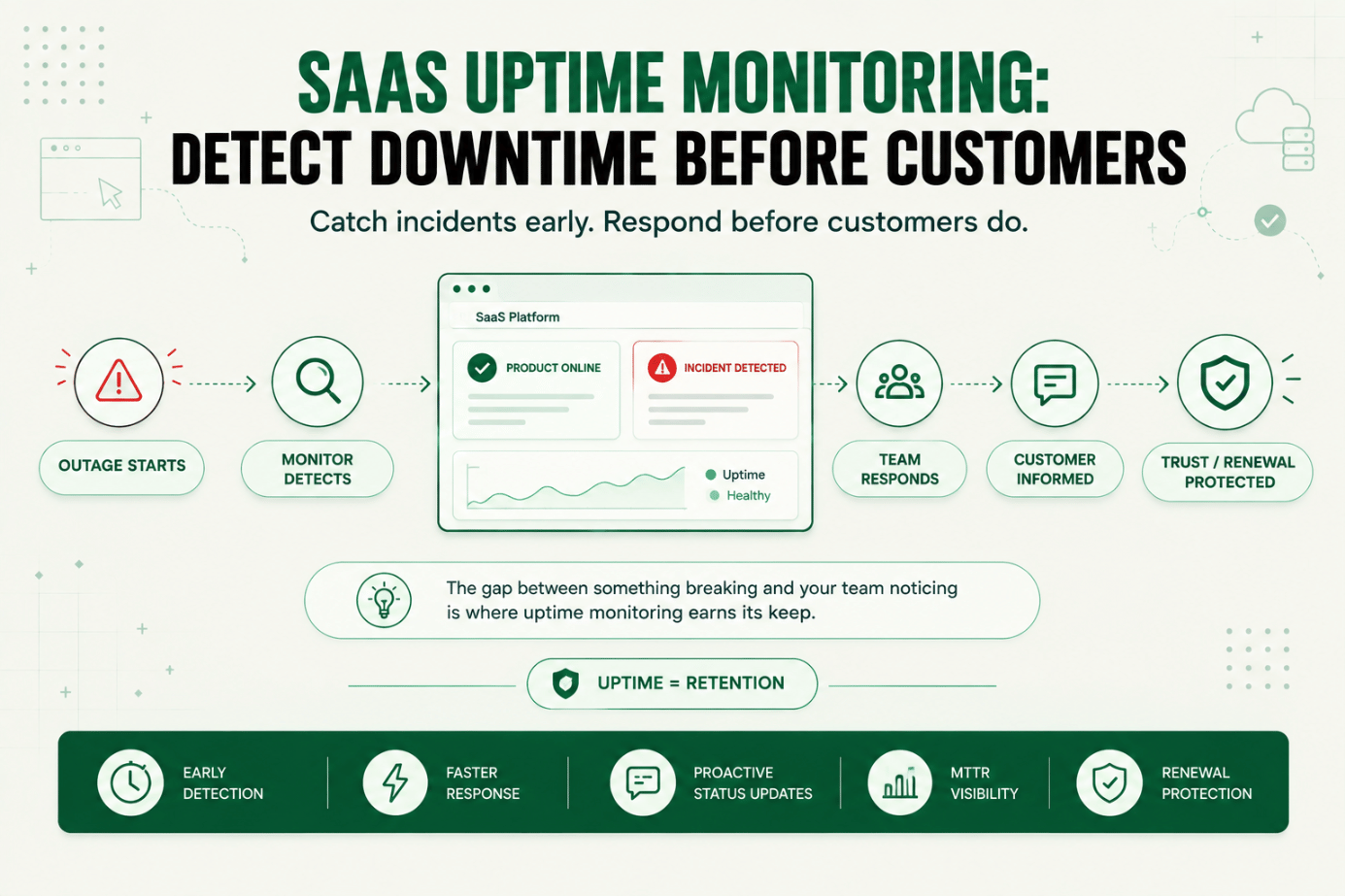
Here's the direct answer, because you probably don't have time for the long version yet: SaaS uptime monitoring isn't just an ops function that keeps servers running. It's a retention system. Downtime doesn't just cost you an hour of engineering time, it costs you renewals, expansion revenue, and the trust that makes a customer stick around through the next price increase. Treat uptime monitoring as a cost center and you'll underinvest in it right up until it costs you a renewal cycle.
Statixoup builds monitoring for SaaS teams who've already learned this the hard way, so this isn't theoretical for us. We've watched a single bad weekend undo six months of a customer success team's relationship-building. And we've watched teams with modest infrastructure keep customers for years because they were honest and fast when things broke. This guide walks through why product uptime SLA performance shows up in your churn numbers, what to actually do about it, and where teams get it wrong.
The Problem: How Silent Outages Erode Trust Before Support Even Notices
Your customer doesn't experience "99.9% uptime." They experience the ten minutes their dashboard wouldn't load during a Monday morning standup. That's the whole relationship, from their side.
And the damage often starts before your team even knows there's a problem. A customer hits an error, refreshes twice, gets frustrated, and closes the tab. Most of them won't file a ticket. They'll just quietly start looking at your competitor's pricing page instead. By the time your support queue shows a pattern, you've already lost the moment where you could have said something first.
This is the part that's easy to miss if you think about reliability as a purely technical problem. The outage itself is bounded, it starts, it ends, MTTR gets logged. But the trust damage isn't bounded the same way. It lingers into the renewal conversation months later, disguised as "we're evaluating other options" instead of "you went down on us in March."
SaaS Uptime Monitoring and the Real Link Between SLA, NPS, and Renewals
Here's the pattern, stated plainly: teams that treat SaaS uptime monitoring as a retention input, not just an incident-response tool, see fewer surprise cancellations. Not because their infrastructure is flawless. Because they know about problems before customers do, and they've built the muscle to say something before support gets the angry email.
Product uptime SLA targets are a promise, not a spec sheet
A product uptime SLA isn't really about the number. 99.9% and 99.95% look nearly identical on paper, but the difference is about 43 minutes versus 22 minutes of downtime a month. Customers rarely do that math. What they remember is whether the outage happened during a moment that mattered to them, and whether anyone told them what was going on while it was happening.
SLAs matter most as a communication contract. When you publish one, you're telling customers exactly what "acceptable" looks like, and giving your own team a number to be honest against instead of quietly hoping nobody notices.
How downtime bleeds into your NPS score
NPS surveys rarely ask "did you experience an outage." But ask any customer success lead and they'll tell you the score dips for weeks after a bad incident, even for customers who weren't directly affected. Word travels inside a company. One frustrated admin tells three colleagues, and your promoter score takes a hit that has nothing to do with a feature gap.
According to research compiled from B2B SaaS churn benchmarks, the median monthly churn rate across B2B SaaS sits around 3.5%, split between voluntary cancellations and failed payments, and reliability problems are a recurring driver behind the voluntary side of that number (SaaS churn benchmark data). A 5% improvement in retention can lift profits anywhere from 25% to 95%, a figure Bain & Company has cited for years and one that still holds up. That's the size of the lever we're talking about.
A quick way to see the pattern: incident timing versus renewal timing
- An outage happens 6 to 10 weeks before a renewal date.
- The account goes quiet, fewer logins, slower email responses, no expansion conversation.
- The renewal either shrinks or doesn't happen at all.
The result is a churn event that gets logged as "pricing" or "no budget" in your CRM, when the real cause happened two months earlier and nobody connected the dots.
What Actually Happened: A SaaS Outage and Its Retention Fallout
Picture a mid-market SaaS product, project management software, around 400 paying accounts. A database migration goes wrong on a Thursday afternoon. The core dashboard is unreachable for 90 minutes. Nothing catastrophic by outage standards, no data loss, recovery within two hours.
Here's what didn't work at first: the team fixed the database, posted a one-line status update, and moved on. No follow-up email. No explanation of what happened or what changed to prevent it. Three weeks later, two accounts representing about $18,000 in annual contract value quietly didn't renew. When the customer success team called to ask why, both mentioned the outage, unprompted, as the moment they stopped trusting the platform for anything time-sensitive.
What changed after that: the team started sending a short, specific follow-up after any outage over 15 minutes, what broke, what was done, what changed so it's less likely to happen again. Nothing fancy, just three sentences. Over the following two quarters, churn tied to reliability complaints dropped by roughly a third, based on their own exit-survey tagging. Not because outages stopped happening. Because customers stopped feeling like they'd been left in the dark.
This is a realistic composite drawn from patterns we see across SaaS teams using uptime monitoring, not a single named customer, but it's close enough to something that's probably already happened at your company that it's worth sitting with.
Uptime Monitoring for SaaS Teams: Best Practices That Actually Move Retention
Pulling the useful pieces out of the sections above, here's the shortlist worth actually doing.
- Set your product uptime SLA around what customers actually feel, not just server-side averages: A number that only reflects backend health while ignoring third-party API failures or slow page loads is technically true and practically misleading.
- Communicate proactively, before support gets flooded: A status page update within five minutes of detection buys you goodwill that a perfect apology an hour later can't. Customers forgive outages. They don't forgive silence.
- Track MTTR like it's a retention metric, because it is: Faster recovery isn't just an engineering win. It's the difference between an outage a customer barely notices and one they remember at renewal time.
- Give customer success visibility into incidents in real time: If your CS team learns about an outage from an angry customer instead of your monitoring dashboard, you've already lost the chance to get ahead of the conversation.
- Review incidents against renewal dates quarterly: Pull the accounts that churned or downgraded and check whether an outage happened in the 60 days before. The pattern usually shows up faster than people expect.
Where SaaS reliability monitoring earns its budget
Most finance teams see monitoring tools as a line item next to logging and observability spend. Reframe it: SaaS reliability monitoring is a retention tool with a much clearer ROI trail than most marketing spend, because you can directly tie incident response speed to accounts that stayed.
The Uptime Monitoring Mistakes That Quietly Cost SaaS Companies Renewals
Treating uptime as purely a technical problem: The engineering team fixes the bug, closes the ticket, and moves on. Nobody tells the account owner. Nobody tells the customer why it happened. The technical fix is complete, but the trust repair never started.
Hiding incidents from customers, or minimizing them: A status page that says "investigating" for two hours and then silently flips to "resolved" reads as evasive, even when the team worked hard on it. Customers fill in the silence with worse assumptions than the truth usually deserves.
Publishing an SLA and then never checking whether you're actually meeting it: A product uptime SLA that exists in a sales deck but not in an internal dashboard is a liability waiting to surface during a difficult renewal negotiation.
Measuring uptime in isolation from the customer experience: 99.95% infrastructure uptime doesn't help much if a third-party payment API is timing out for 20 minutes a week and nobody's watching that dependency.
Waiting for a bad renewal season to invest in monitoring: By the time churn numbers move, the trust damage already happened months earlier. Reliability investment works best as a steady habit, not a reaction.
Conclusion
Reliability isn't a cost center you tolerate until something breaks badly enough to justify the spend. It's a retention lever, quietly compounding in either direction every time something goes down and your team either says something useful or doesn't. The SaaS companies keeping their renewal numbers healthy aren't the ones with zero incidents. They're the ones who caught problems early and told customers the truth about them fast.
The uncomfortable part is that most of this damage is invisible until it shows up as a churned account three months later with "no budget" typed into the CRM notes. By then, the fix that would have actually worked was a five-minute status update back in March.
Start Here
If reliability has been sitting in the "engineering's problem" bucket at your company, that's worth revisiting this quarter, not next year. Statixoup runs a 30-day trial built for exactly this: set up your first product uptime SLA-based monitor, connect it to a status page your customers can actually check, and see what your real incident pattern looks like before your next renewal cycle hits.
Ready to Make Uptime Part of Your Retention Strategy?
Statixoup helps SaaS teams monitor uptime and reliability so they can detect incidents earlier and respond before customers do. You can get started for free, explore the pricing page, review the documentation, or reach out to the team if you're not sure where to start.
Post a Comment

Hardik Vaghani
Hardik Vaghani is a Digital Marketing Professional and SEO Strategist based in Surat, Gujarat, India. He currently works with Ethnic Infotech, contributing to SEO, content marketing, technical SEO, and digital growth strategies. Hardik also creates blog content for Fusion5, focusing on technology, laptops, and consumer electronics. With expertise in SEO, Google Ads, Meta Ads, Local SEO, and Content Strategy, he helps businesses improve online visibility, rankings, and lead generation through data-driven marketing.
Frequently Asked Questions
Related Blogs