How Web Agencies Can Offer Uptime Monitoring as a Retainer Service
Most clients only hear from their agency when something breaks. This guide shows how to turn uptime monitoring for agencies into a steady retainer service that clients can see working every month. You’ll learn what to include, how to price it, and how to set up a simple tier around uptime alerts and reports. It also covers reporting cadence, escalation ownership, and the common mistakes that make monitoring feel worthless to clients.
Why Maintenance Retainers Are Easier to Sell With Monitoring Built In
Uptime monitoring for agencies is the most visible part of a maintenance retainer, because it is the one thing a client can actually see working. Updates, backups and security patches happen quietly in the background. A monitor that catches an outage at 2 a.m., an alert that reaches your team before the client's customers notice, and a monthly report showing 99.9% uptime are all things a business owner understands without a technical explanation.
That is the core idea of this guide, and it is exactly the kind of work Statixoup was built for. If you run a web agency, you already build sites, and many of your clients already pay you something each month (or did, until they asked what they were paying for). Putting monitoring and reporting at the centre of the retainer gives the client proof every month, and gives you a steady reason to stay in touch.
The money case is real as well. The Admin Bar's State of the WordPress Agency 2026 survey (622 respondents across 51 countries, conducted February to March 2026) found that agencies with no recurring revenue were rarely or never profitable 58.3% of the time. Among agencies earning 25% to 49% of their revenue from recurring work, that figure fell to 9.7%. The survey also adds a fair caveat: stronger agencies tend to move toward retainers anyway, so the model reflects a healthy business as much as it creates one. This is a link rather than proof of cause. Still, the direction is hard to ignore.
Problem Statement: Clients Who Only Hear From Their Agency When Something Breaks
Here is a pattern most agency owners will know. You launch a site, the client is happy, and then nothing happens for months. The next time they hear from you is when the contact form stops working, the SSL certificate expires and browsers show a security warning, or the site goes down during a sale.
Worse, the client often finds out first. A customer emails them, or they notice it themselves, and then they call you. From their side, the agency was not watching.
Why silence hurts retention
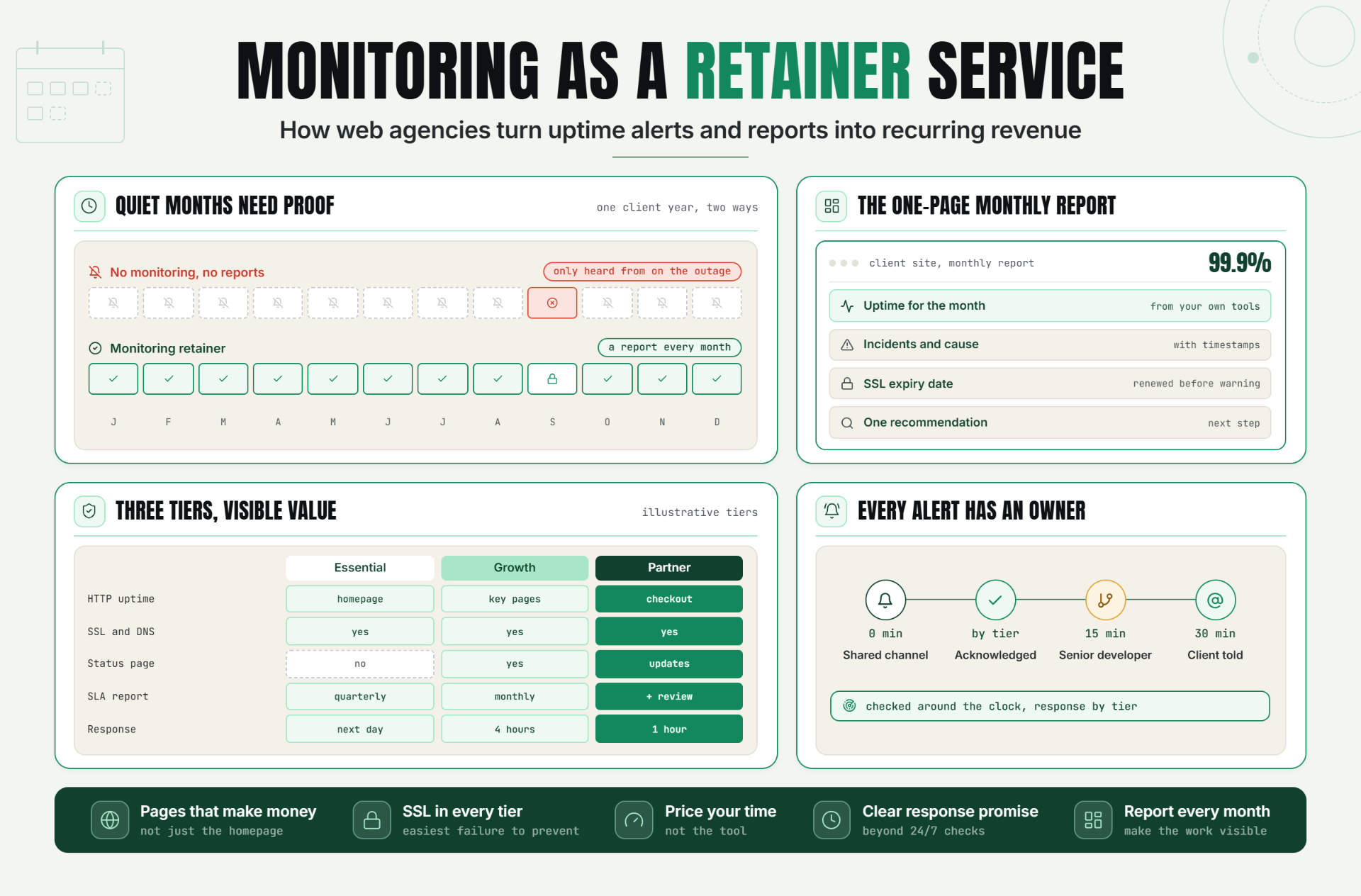
When the only contact is about problems, the relationship starts to feel like a cost. At renewal time, the client remembers the outage, not the eleven quiet months when everything worked. Without evidence, "nothing happened" looks the same as "nobody was paying attention."
Why downtime matters to the client's business
The money at risk is not small. In its May 13, 2026 press release for the 8th Annual Outage Analysis, Uptime Institute reported that 57% of respondents to its 2025 Annual Survey said their most recent major outage cost more than $100,000, and for the second year running, 1 in 5 reported costs above $1 million. Those figures come from data center and IT operators, not small business websites, so do not quote them to a local bakery as their likely loss. A better approach is to run the client's own numbers through Statixoup's free Downtime Cost Calculator, which estimates lost revenue and productivity from outage time.
What to Include in a Monitoring Retainer and How to Price It
A good monitoring retainer is not "we installed a tool." It is a clear promise about what you watch, how fast you respond, and how you report.
The monitoring layer
These are the checks that catch most client-facing failures. Statixoup's homepage lists support for each of them:
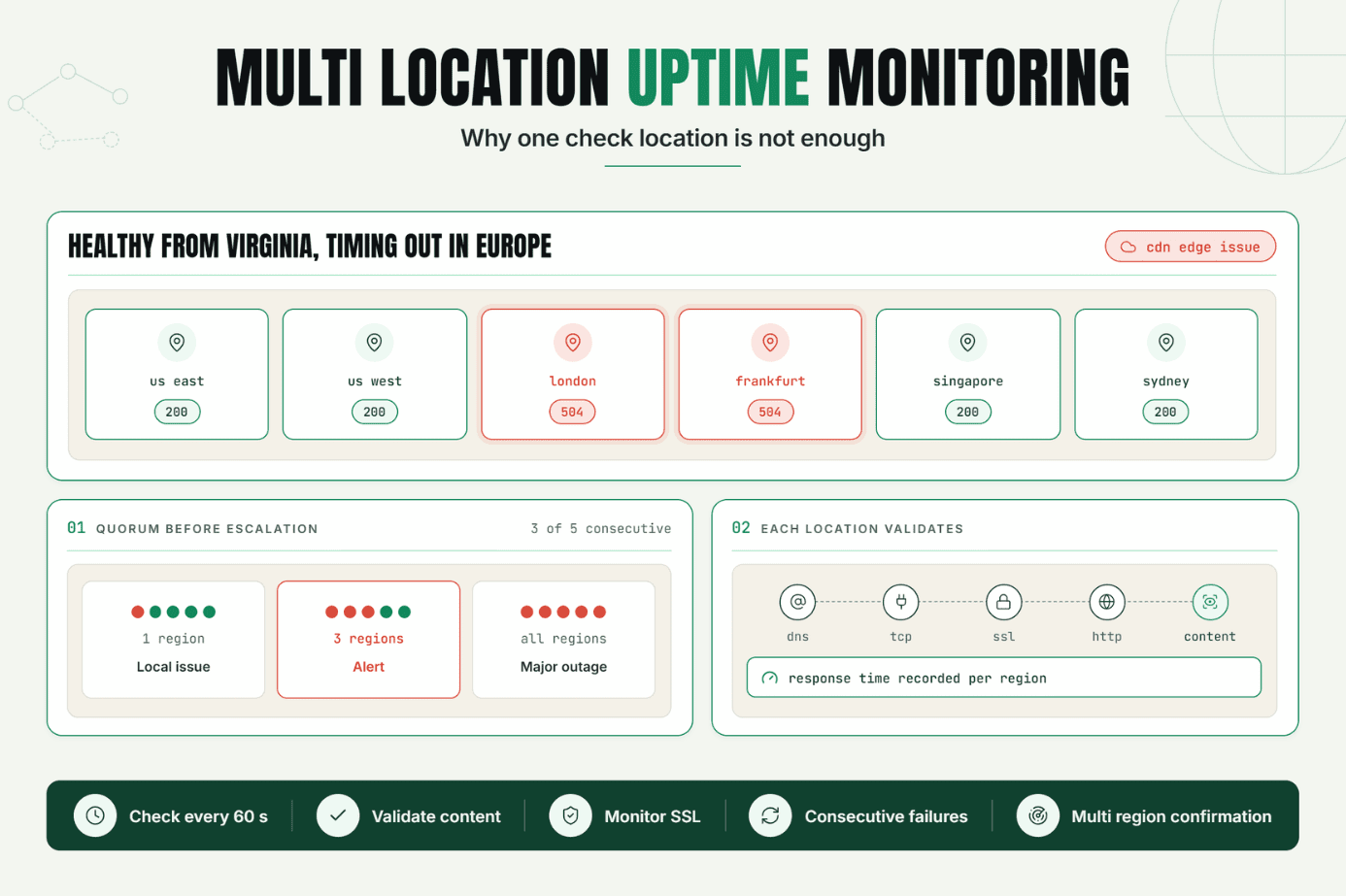
- Website (HTTP) uptime and response time: checks from multiple regions (see how Statixoup's website monitoring services work), so one bad network path does not trigger a false alarm. Statixoup says it checks every 30 seconds and verifies a failure before alerting.
- SSL certificate monitoring: expiry and validity warnings, so certificates get renewed before browsers start warning visitors.
- DNS monitoring: change detection and global DNS checks, which help catch broken records after a domain or hosting change.
- Port and infrastructure checks: useful for clients with mail servers, databases or custom services.
- Heartbeat (cron) monitoring: for scheduled jobs such as backups, feed imports or order syncs that fail silently.
The alerting and response layer
Monitoring only matters if someone acts on it. Decide who gets alerted, through which channel, and what happens next. Statixoup supports email, Slack, Discord, WhatsApp, SMS and voice call alerts. Many agencies send routine alerts to a shared Slack or Discord channel and escalate to SMS or voice call for confirmed outages on high-value sites.
The reporting layer
This is where retention is won.
Statixoup's agency section lists branded public status pages per client, professional SLA reports for billing, unlimited monitor checks across clients, and centralized incident management. Status pages are hosted on a personalised Statixoup subdomain.
How to price it
There are three common ways to price monitoring inside a website maintenance retainer:
- Per site, per month: simple to explain and scales cleanly with your client list.
- Tiered bundles: monitoring sits inside Essential, Growth and Partner plans alongside updates, backups and edit time.
- Value-based: priced against what an hour of downtime would cost the client, using the Downtime Cost Calculator as the conversation starter.
Whichever you pick, start from your costs: your monitoring tool subscription spread across clients, the minutes you spend each month on alert triage and reports, and a margin that still holds when a client has a bad month. For comparison, Kyle Van Deusen of The Admin Bar, in his article What is a Website Care Plan and What's Included?, reviewed more than 100 agency care plan pages and found it rare to see anything under $75, with most between $100 and $150 and the top end around $250. Treat that as one data point from the WordPress market, not a rule. Then compare it with your own tool cost on the Statixoup pricing page.
A Sample Retainer Tier Built Around Uptime and Reporting
The table below is an illustrative example only. The prices are not market data, not Statixoup prices, and not recommendations for your area. They show one way to structure tiers so that the monitoring value is visible. Change them to fit your costs, region and clients.
| Feature (illustrative) | Essential | Growth | Partner |
| Example price, India (per site/month) | ₹1,500 to ₹3,000 | ₹4,000 to ₹8,000 | ₹10,000 to ₹20,000 |
| Example price, international (per site/month) | $29 to $59 | $79 to $149 | $199 to $399 |
| HTTP uptime monitoring | Homepage | Homepage + key pages | Key pages + checkout/login flows |
| SSL and DNS monitoring | Yes | Yes | Yes |
| Port / heartbeat monitoring | No | Optional | Yes |
| Alert channels to agency | Email + Slack/Discord | Email, Slack, SMS or voice call | |
| Client-facing status page | No | Yes | Yes, with incident updates |
| Uptime / SLA report | Quarterly | Monthly | Monthly + quarterly review call |
| Response target (business hours) | Next business day | 4 hours | 1 hour |
| After-hours escalation | No | No | Yes, confirmed outages only |
All prices are illustrative examples for planning, not facts or quotes. Check local market rates, taxes (such as GST in India) and your own costs before publishing any price.
How this plays out (hypothetical)
Picture a hypothetical agency with 20 small business clients. It moves eight of them onto the Growth tier. Each month those clients get a one-page report: uptime percentage, any incidents with timestamps and cause, the SSL expiry date, and one recommendation. When an SSL certificate is about to expire, the agency renews it and mentions it in the report. The client never sees a browser warning, but they do see the agency caught it. This is an example scenario, not a client result.
Reporting Cadence, Escalation Ownership, Client-Facing Dashboards
Set a reporting cadence and keep to it
Monthly works for most retainer clients.
Keep the report short: status for the month, incidents and causes, what you fixed, and one suggestion. Only report numbers you can see in your own tools. If a month was quiet, say so and show the uptime figure. A quiet month is the product working.
Write down escalation ownership
Every alert needs a named owner. Decide:
- Who gets the first alert (on-call person or shared channel)
- How fast they acknowledge it (tie this to the tier)
- When it escalates (for example, unacknowledged after 15 minutes goes to a senior developer)
- When the client is told (for example, within 30 minutes of a confirmed outage on Partner sites)
Statixoup's homepage mentions team collaboration, alert routing and role-based access for teams. Map your escalation rules to those features during setup.
Use client-facing dashboards carefully
A status page gives clients, and their customers, a place to check during an incident instead of flooding your inbox. Set up one status page per client and name components in plain language ("Online store," "Booking form") rather than server names. Statixoup's docs include a status page setup guide.
Keep internal and client views separate
Clients should not see your full monitoring dashboard with every other client's sites. Share the status page and the report, and keep configuration internal.
Underpricing Monitoring, No Clear Incident Response Promise
Underpricing because "the tool does the work"
The tool is cheap. Your attention is not. Triage, false-alarm checks, client communication and reports all take time. If monitoring is a free extra, clients treat it as worthless, and you resent the 11 p.m. alert.
Promising "24/7 monitoring" without a response promise
Monitoring runs 24/7. Your team probably does not. Separate the two clearly: "Your site is checked around the clock. Confirmed outages on your plan get a response within X hours during business hours." Vague promises create disputes after the first incident.
Monitoring only the homepage
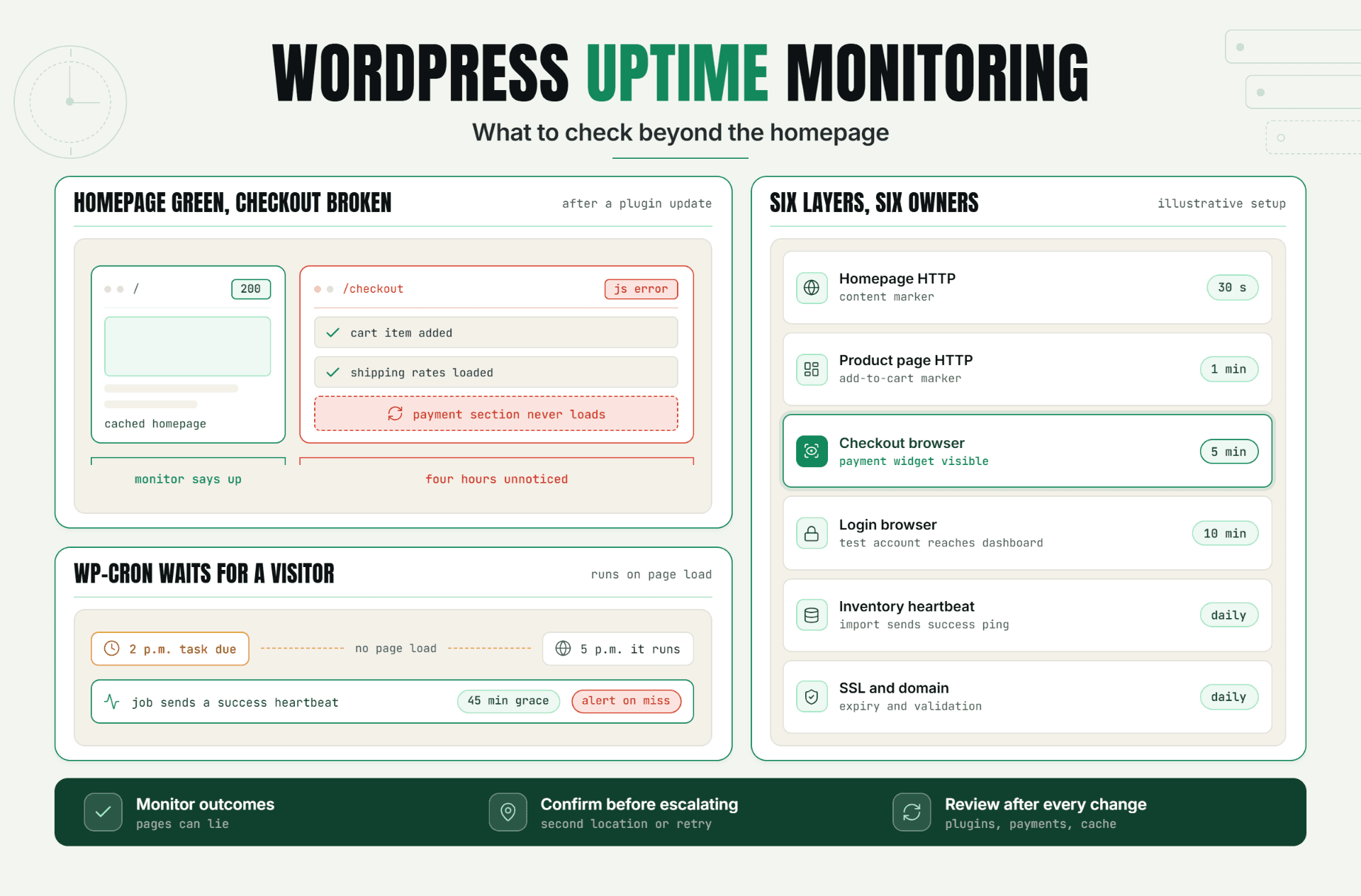
A homepage can return a normal response while checkout, login or forms are broken. Monitor the pages that make the client money.
Hiding the work
If clients never see a report, they will not miss the service when they cancel it. Make the value visible every month.
Ignoring SSL and domain expiry
These are the easiest failures to prevent and among the most embarrassing to miss. Add SSL monitoring to every tier. If you also monitor client integrations, our guide to webhook monitoring covers delivery and retry checks.
Monitoring as a Low-Effort, High-Trust Addition to Retainers
Uptime monitoring is one of the few retainer services that proves itself. It runs in the background, catches problems early, and turns into a report clients can read in under a minute. For agencies, that means steadier recurring revenue and fewer awkward "what am I paying for?" conversations.
The work is mostly in the setup: choose what to monitor, write down who responds and how fast, price for your time rather than the tool, and report every month without fail. Do that, and monitoring stops being a hidden cost and becomes the clearest part of your website maintenance retainer.
Start a Statixoup Trial and Set Up Your First Client Monitors
Pick three client sites: your busiest, your most fragile, and one where renewal is coming up. Run each through the free Website Uptime Checker, then estimate what an hour of downtime would cost each client with the Downtime Cost Calculator. For a wider look, try the website health check. Bring those numbers to your next client call.
When you are ready, start Statixoup's 7-day free trial (no credit card needed) and set up HTTP, SSL and DNS monitors for those three sites, plus a status page for at least one of them. Use the trial to send your first monthly report before the trial ends.
Post a Comment

Hardik Vaghani
Hardik Vaghani is a Digital Marketing Professional and SEO Strategist based in Surat, Gujarat, India. He currently works with Ethnic Infotech, contributing to SEO, content marketing, technical SEO, and digital growth strategies. Hardik also creates blog content for Fusion5, focusing on technology, laptops, and consumer electronics. With expertise in SEO, Google Ads, Meta Ads, Local SEO, and Content Strategy, he helps businesses improve online visibility, rankings, and lead generation through data-driven marketing.
Frequently Asked Questions
Related Blogs