Incident Severity Levels: Practical SEV-1 to SEV-4 Guide
Learn how to define incident severity levels from SEV-1 to SEV-4 based on customer impact, urgency, and business risk. This guide includes a practical severity matrix, escalation rules, real-world examples, and best practices for responding to outages effectively.
That gap is exactly why incident severity levels matter. For Statixoup users monitoring websites, APIs, SSL certificates, ports, and customer journeys, severity is the shared language that turns evidence into an agreed response. The proof point isn't a marketing claim: PagerDuty's published framework maps each SEV tier to a different response, while Google SRE recommends declaring incidents early when customers can see the outage, a second team is required, or an issue remains unsolved after an hour.
Incident severity levels classify the current business and customer impact of an incident, usually from SEV-1, the most serious, through SEV-4, the least serious. A good definition specifies impact, urgency, ownership, response time, update frequency, and communication. It can change as evidence changes.
The Problem With Undefined Severity
Without written incident severity levels, teams classify the same event differently. Support judges the number of complaints. Engineering looks at error rates. Leadership focuses on revenue or contractual risk. Every view may be reasonable, but the response becomes improvised.
That creates two expensive failure modes. The first is underreaction: a regional checkout failure sits in a normal queue because the homepage still returns HTTP 200. The second is overreaction: a single failed background job pages the full incident team at 3 a.m. Repeated overreaction feeds alert fatigue, a problem covered in Statixoup's guide to alert fatigue in DevOps.
PagerDuty reported in 2024 that its survey of 500 IT leaders found an average customer-facing incident took 175 minutes to resolve. The same survey reported that 90% said outages or disruptions had reduced customer trust. Those figures describe large organizations, so they shouldn't be treated as a forecast for every Statixoup customer. They do show why wasting the opening minutes on classification arguments is a poor bargain.
How Incident Severity Levels Work
Incident severity levels answer one question: how bad is the impact right now? They don't explain root cause, assign blame, or promise a resolution time. Severity guides the intensity of response while monitoring and investigation supply the evidence.
Most teams use the lower-number-is-more-urgent convention. PagerDuty, for example, classifies SEV-1 as its most serious tier and advises teams to choose the higher level when they are uncertain, then review the decision later. Your numbering can differ. Consistency matters more than copying somebody else's labels.
Separate impact from urgency
Impact measures what customers and the business are experiencing. Ask how many users are affected, which journey is broken, whether data is at risk, whether an SLA is threatened, and whether a workaround exists.
Urgency measures how quickly the condition could worsen or how quickly action must begin. A certificate expiring in 20 days may have high future impact but low immediate urgency. A certificate that expired five minutes ago on the payment domain has both. Good incident severity levels keep those two dimensions visible.
This distinction prevents outage priority from becoming a contest over who speaks loudest. It also connects cleanly with Statixoup's explanation of MTTD versus MTTR, because classification should happen after detection but before response fans out.
Use observable thresholds, not adjectives
Words such as “major,” “some,” and “slow” invite debate. Replace them with thresholds tied to your service, because incident severity levels fail when responders must interpret loose adjectives.
For a SaaS product, define the affected-user range, failed transaction percentage, latency threshold, duration, region count, and critical journeys. A SEV-2 might mean more than 20% of active users can't sign in for five minutes. A SEV-3 might mean one non-critical integration is delayed while a workaround remains available.
Thresholds need business context
Numbers alone can still mislead. A 5% checkout failure during a quiet hour and a 5% failure during a product launch carry different revenue exposure. Define override conditions for security, data loss, legal obligations, and peak trading periods.
Google SRE's incident management guidance recommends clear roles for command, operations, communication, and planning. Severity should activate those roles, not merely decorate a ticket.
A Practical SEV-1 to SEV-4 Matrix
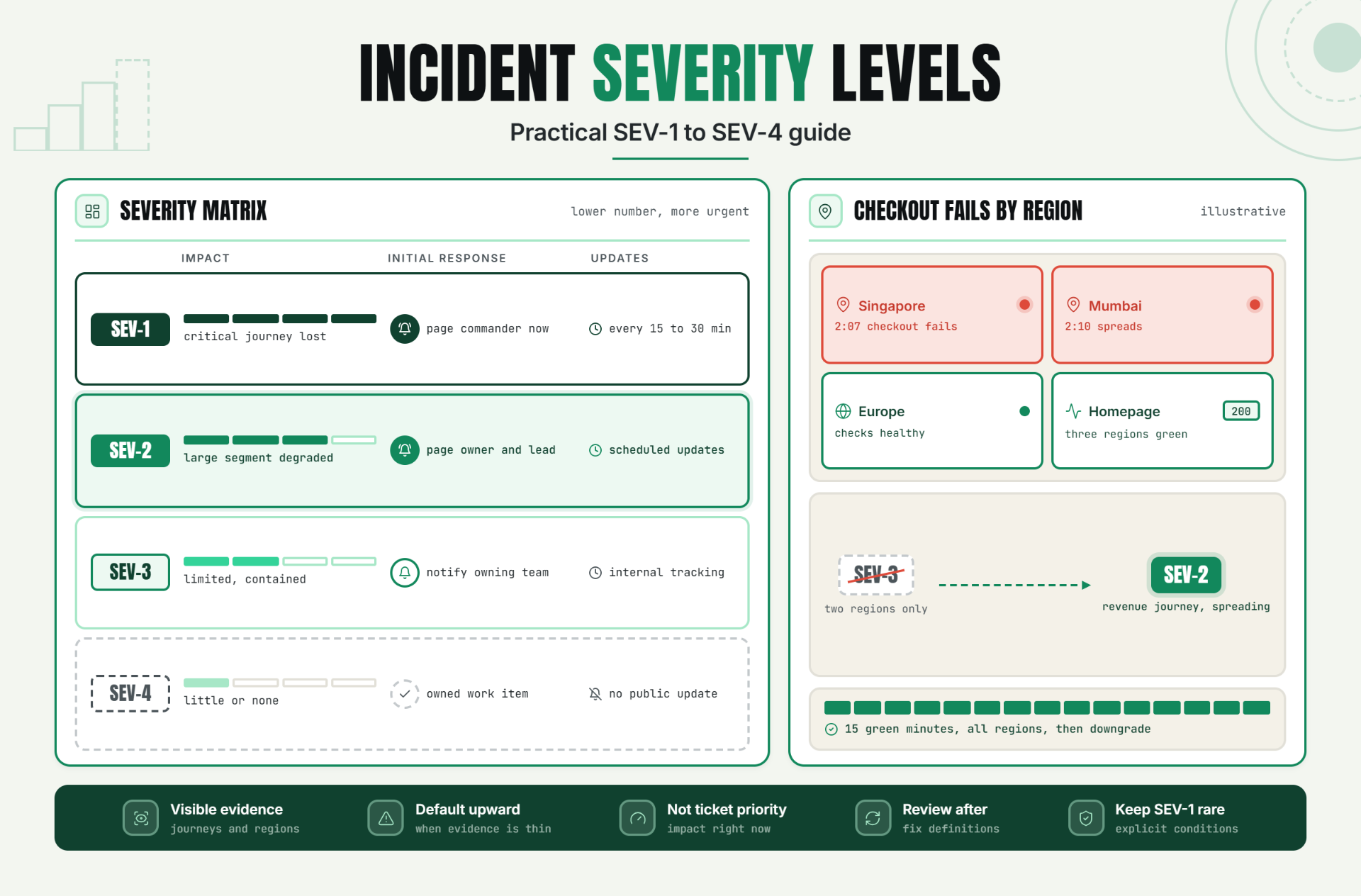
The incident severity levels matrix below is a starting point, not an industry law. Adjust the percentages, response targets, and communication cadence to your risk profile.
| Level | Typical impact | Initial response | Communication | Example |
|---|---|---|---|---|
| SEV-1 | Widespread loss of a critical journey, confirmed data exposure, or severe revenue impact with no workaround | Page incident commander and primary responders immediately | Internal updates every 15 to 30 minutes; public update when customer impact is confirmed | Login unavailable to nearly all customers |
| SEV-2 | Major degradation or material impact to a large segment, possibly with a weak workaround | Page service owner and incident lead | Scheduled stakeholder updates; status page if customers are affected | Checkout fails in two regions |
| SEV-3 | Limited customer impact, contained degradation, or a non-critical dependency failure | Notify owning team during the agreed support window | Internal tracking; external update only if useful | Reporting export delayed for one account tier |
| SEV-4 | Minor issue with little or no current customer impact | Create an owned work item | No routine public communication | One redundant node fails while capacity remains healthy |
Notice what the table doesn't include: root cause. You won't know that reliably during the first few minutes. Classify the observed impact, then revise the incident classification when better evidence arrives.
Build the escalation matrix before the alert fires
An escalation matrix should answer six things for every tier: who is paged, who leads, who can approve risky mitigation, who communicates, how often updates go out, and what evidence permits a downgrade. That is where incident severity levels become operational rules instead of labels.
Use this short process:
- List critical customer journeys.
- Define measurable impact bands.
- Map each band to SEV-1 through SEV-4.
- Assign owners and acknowledgment targets.
- Write communication rules.
- Test the framework in a tabletop exercise.
The result is a matrix responders can use without negotiating during an outage.
Route the alert using service ownership and evidence, not a broad distribution list. Statixoup's guide to incident alert routing explains how ownership, escalation, and channel choice fit together.
A Realistic Production Example: Checkout Fails in One Region
Consider this illustrative case. It is not a claimed Statixoup customer result.
At 2:07 p.m., an HTTPS monitor reports successful homepage responses from three regions. A browser journey, however, fails at the final checkout step in Singapore. API checks show elevated 502 responses from the payment provider endpoint. At 2:10 p.m., the same journey fails from Mumbai, while European checks remain healthy.
The first responder classifies the event as SEV-3 because only two monitoring regions are failing. That's the wrong signal to emphasize. Checkout is a revenue-critical journey, there is no working payment alternative in those regions, and the failure is spreading.
The incident commander raises it to SEV-2, pages the commerce and integration owners, and assigns one person to customer communication. The team's incident severity levels make that routing automatic. The team validates the failure from a second location, pauses a recent routing change, and publishes a scoped status update. When checkout succeeds for 15 continuous minutes across all monitored regions, the event is downgraded and then resolved.
What changed? The team used customer journey impact rather than raw alert count. This is why a homepage-only check is too weak for incident severity levels. Statixoup's guide to transaction monitoring shows how login, signup, and checkout checks expose failures that simple uptime checks miss.
Recommended monitor setup for the example
- · Run HTTP checks for the storefront and payment API from multiple locations.
- · Run a browser checkout journey every one to five minutes, using a safe test transaction path.
- · Validate alerts from a second location before escalation when the risk allows it.
- · Track response code, latency, assertion result, region, dependency, and first-failure time.
- · Route critical-journey failures to the service owner and incident lead.
- · Link the alert to the severity matrix, runbook, status page, and communication template.
This setup doesn't determine incident severity levels by itself. It gives the incident commander the evidence needed for a defensible impact assessment.
Best Practices for Reliable Incident Classification
Tie every tier to customer-visible evidence
Define incident severity levels using failed journeys, affected users, regions, error rates, data exposure, and workarounds. Infrastructure signals matter, but “CPU is high” is not a customer impact statement. Review those incident severity levels with support as well as engineering.
Default upward when evidence is incomplete
If a responder is choosing between SEV-1 and SEV-2, start at the higher tier. PagerDuty's severity-level guidance recommends this approach because it is easier to downgrade after facts arrive than to recover time lost through underreaction.
Keep severity separate from ticket priority
Severity describes current impact. Priority describes when planned work should be completed. A repaired SEV-1 may create several high-priority follow-up items, but those tickets are no longer active SEV-1 incidents.
Review the matrix after incidents
Ask whether the original classification matched the evidence, whether the level changed at the right time, and whether routing followed the matrix. Don't turn this into a performance grade for the responder. Use it to improve definitions.
Test communication at the same time
Each tier needs an internal update cadence and a rule for customer communication. This makes incident severity levels useful to support and leadership, not just engineers. A status page is not the same as an internal monitoring view. Statixoup explains the distinction in status page versus monitoring dashboard.
Common Mistakes That Break Incident Severity Levels
Everything becomes SEV-1
This usually happens when teams use severity to get attention. Soon, the escalation matrix means nothing. Reserve SEV-1 for explicit, measurable conditions and give service owners another route for urgent but non-critical work. Incident severity levels only work when the top tier stays rare.
Severity never changes
The first classification is a hypothesis based on limited evidence. New regions may fail, a workaround may appear, or customer reports may reveal broader impact. Incident severity levels must move with those facts. Record why the level changed and when.
Alert count becomes the impact assessment
Twenty alerts can come from one dependency failure. One browser alert can reveal a broken checkout affecting every buyer. Correlate signals around the customer journey before deciding.
The matrix names teams, not people or roles
“Notify engineering” isn't ownership. Name the on-call service role, incident commander, communication lead, backup path, and acknowledgment target.
Teams automate routing before fixing noisy checks
Automation moves bad signals faster. Validate from multiple locations and reduce false positives first. Statixoup's guide to reducing false-positive alerts covers confirmation rules, thresholds, and retry design.
Conclusion
The best incident severity levels are boring during an outage. Nobody debates the labels because the thresholds, owners, and communication rules were settled earlier. Evidence arrives, the team assigns a tier, and the response moves.
Start with one critical journey and four measurable incident severity levels. Then test the matrix against your last three incidents. If the same evidence produces the same classification across engineering and support, the framework is doing its job.
Start a 30-Day Statixoup Beta
Start a 30-day Statixoup beta and configure monitoring for the customer journey that would trigger your highest-severity response. Add regional validation, alert ownership, and the relevant runbook link. Then use the resulting evidence in a tabletop exercise to pressure-test your severity matrix before the next outage.
Editor note: Add the approved Statixoup author bio, role, photo, and profile link before publishing. No author credentials were assumed in this draft.
Start a 30-Day Statixoup BetaPost a Comment

Hardik Vaghani
Hardik Vaghani is a Digital Marketing Professional and SEO Strategist based in Surat, Gujarat, India. He currently works with Ethnic Infotech, contributing to SEO, content marketing, technical SEO, and digital growth strategies. Hardik also creates blog content for Fusion5, focusing on technology, laptops, and consumer electronics. With expertise in SEO, Google Ads, Meta Ads, Local SEO, and Content Strategy, he helps businesses improve online visibility, rankings, and lead generation through data-driven marketing.
Frequently Asked Questions
Related Blogs